Renting a Country House for 8: the Splitting Traps
Unequal rooms, people who arrive a day late, meals we improvise versus dinners out. A country house for eight people is not split by adding up the bills and dividing by eight. You have to design the system before you leave the city.

The bill that looked simple
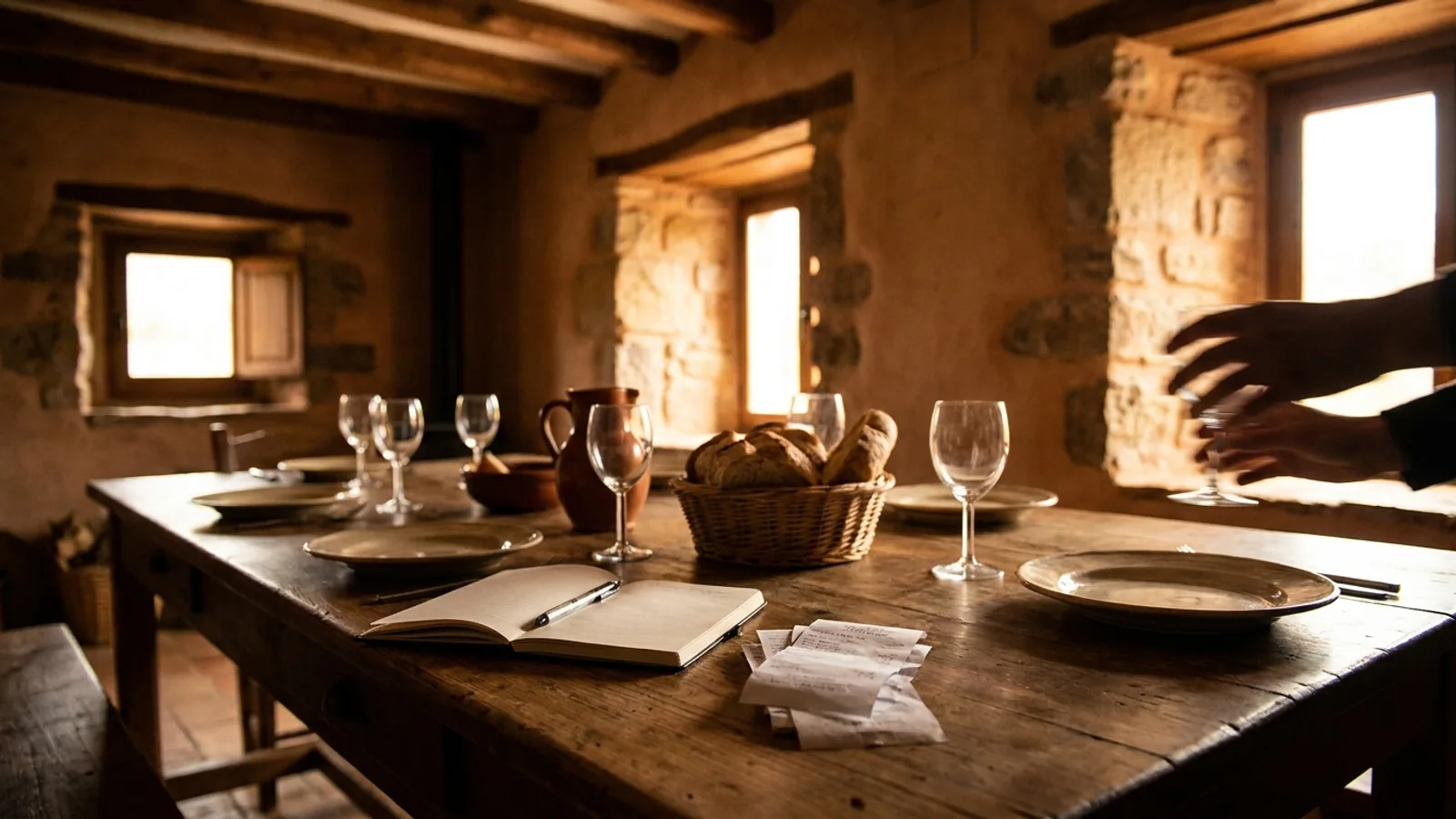
A group of eight friends books a country house somewhere in the mountains. The plan is three and a half nights: from Thursday afternoon to Sunday morning. The house costs 1,040 euros with cleaning included. Someone says in the group chat: 130 a head, okay? And everyone replies with a thumbs up. Apparent unanimity.
What happens next is what I know all too well. Two of the eight arrive on Friday afternoon because one had a quarter-end deadline and the other is their partner. Three head back on Saturday night because they have a family commitment on Sunday. One of the rooms is a suite with an en-suite bathroom and a double bed; another is an attic with two bunk beds and a mattress on the floor. There are three dinners, two of them cooked at home and one in a restaurant in the village. One person did the supermarket shop, another the butcher's, a third brought the wine. And on Monday the inevitable question appears in the chat: hey, how do we settle this?
What looked like 130 a head is not 130 a head. And the problem is not the money; it is the eight parallel calculations each person has been running in their head since the first night.
Why a flat split creaks in groups of eight
A flat split works in two scenarios and only two. Either everyone consumes exactly the same, or the group is small enough that the asymmetries cancel out without any bookkeeping. On a weekend away as a couple, if you pay for dinner and I pay for breakfast, nobody keeps count. In a group of eight, the asymmetries don't cancel out: they pile up. The good room is worth more, the two extra nights are worth more, Saturday's restaurant dinner was pricier than the two dinners at home, and whoever brought six bottles of a decent wine has spent as much as the entire supermarket shop.
On top of this comes a phenomenon familiar to anyone who has organised a group trip: asymmetric memory bias. Whoever paid for something remembers it. Whoever paid for nothing also remembers what the others paid, but less precisely. If nobody keeps a centralised record, after a week the group remembers contradictory fragments and, worse, remembers emotions. It remembers that one of them complained about the supermarket price, that another was slow to pay for the restaurant, that the couple who arrived late didn't contribute to Friday's breakfast. And all of that weighs more than the actual balance.
Designing the system before leaving the city
The only way for a trip of eight people to end without tension is to design the splitting system before you pack your bag. Not afterwards, not on the way back, not in an awkward conversation in the car. Before. And that design has three blocks.
1. The accommodation is split per night and room, not per head
The house costs 1,040 euros for three and a half nights. If we prorate it per person-night, we have a real denominator. Of the eight, five sleep all four nights (Thursday to Sunday), two sleep three (Friday to Sunday) and one sleeps two (Friday and Saturday). Total person-nights: 5x4 + 2x3 + 1x2 = 28. Cost per person-night: 1,040 / 28 = 37.14 euros.
That already corrects for whoever comes for fewer days. But there is still the matter of the rooms. A fair option is to apply a coefficient: the suite costs 40% more than the standard room, the attic 20% less. The coefficient is agreed before assigning rooms, not afterwards. Whoever wants the suite pays the premium. Whoever accepts the attic gets the discount. The rooms are offered, not handed out at random on arrival.
2. Food is run as a common fund with petty cash
The classic mistake is for everyone to pay their share and then add it all up. It is operationally expensive and emotionally costly. The alternative is for a single person to do the big supermarket shop with money from the common fund. Everyone chips in an initial amount on arrival (say 30 euros) and everything spent on food, drink and consumables comes out of that. If there is money left, it is returned. If it falls short, a second top-up is made.
Dinners out are separate. And here you have to decide in advance: do we split evenly or does each person pay what they consumed? In a group of eight with two vegetarians, a pregnant woman who isn't drinking and a couple who ordered a good wine, splitting evenly is a silent transfer from the moderate to the lavish. The honest option is to pay for what each person had and leave the tip in common.
3. The extras have their own category
The four bottles of good wine one of them brought, the firewood for the fireplace another one paid for, the trip to the guided hiking activity that six of the eight took part in. Each of these expenses has a different perimeter: the firewood is used by all eight, the wine was drunk by six (two don't drink), the activity was done by six. Throwing everything into the same bag distorts things. You have to record each expense with who pays for it, how much it costs and among whom it is split.
The problem of the last day and the cents
There is a second layer of friction people don't anticipate: the settlement. When you reach the last day, you have a sheet with forty-three movements and you need to turn it into transfers. If you do it with a calculator, you are going to spend two hours and argue three times. And then comes the petty but real detail of the cents: if I split 100.01 euros among three people, it is not 33.33 each, because that adds up to 99.99 and one cent is missing. Multiply that by forty movements and you have discrepancies nobody can explain.
A decent system distributes the cents by largest remainder, not by truncation, so nobody always pays the rounding. And, above all, it calculates the graph of minimal transfers: if A owes B twenty euros and B owes C twenty euros, A pays C directly and we save a movement. Multiply that by eight people and the difference is operational.
How to automate it without turning the trip into a spreadsheet
The solution is not to bring an Excel sheet to the mountains. It is to record each expense on the spot, from your phone, with three pieces of data: who pays, how much, and among whom it is split. Any decent system should let you define asymmetric groups per expense (this is paid by one and split among six, not eight), apply coefficients to the rooms, prorate by actual nights and, at the end, return the graph of minimal transfers with the split correct to the cent. ControlarGastos does exactly that, and that frees the organiser from also having to be the accountant.
The key operational point: one person in the group is appointed responsible for recording expenses in real time. Not for paying them, just for noting them. That reduces the cognitive load on the rest and removes the risk of receipts getting lost in a trouser pocket.
Conclusion: the trip is what you remember, the split is what you forget
A weekend trip among eight friends is remembered for the good things: the long dinner, Saturday's hike, the late-night conversation by the fireplace. What destroys those memories six months later is the residual feeling that someone paid too little, or that the settlement was tense. The function of the splitting system is not mathematical, it is protective: it protects the friendship from the arithmetic. If you design it before you leave, you arrive at the house with a clear mind. And you come back with a clean transfer and the feeling that it was, quite simply, a good weekend.
Keep reading

Beers at the bar: the phone-calculator ending
Three rounds, eight beers, three plates of patatas bravas, two alcohol-free drinks. The arithmetic at the end can take fifteen minutes or thirty seconds. The difference is in how you model the problem before you order.
The friend who always pays less: bring it up or stay quiet?
In every group there's one who orders the cheapest thing, leaves early or pays the bare minimum. How to spot the pattern, when it's worth bringing up and when it's better to accept it as system noise.

Concerts and Festivals: Tickets + Parking + Beers
A three-day festival isn't 200 euros, it's 600. How to budget a weekend with friends four months ahead so nobody drops out in July by surprise.
Sound familiar?
ControlarGastos automates splitting expenses with your partner, flatmates and friends. Split to the cent, no arguments.
Start for free