Pizza for 6 with 4 Meat-Eaters and 2 Vegans: The Fair Split
The margherita is cheaper than the four-cheese, and the porcini vegan costs the same as the barbecue. Splitting the total six ways looks fair, but it only is if everyone eats the same in value.

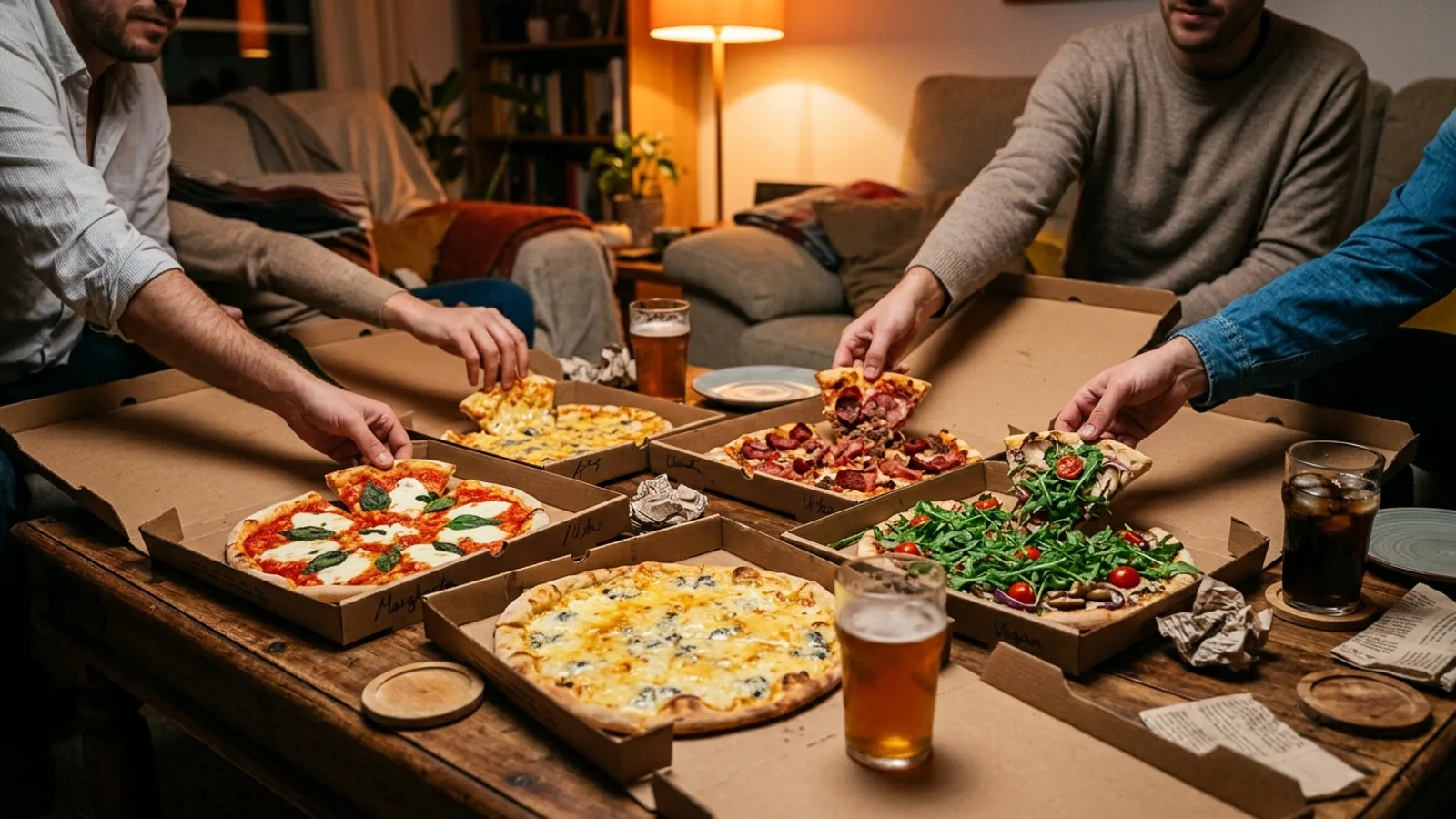
The split that looks fair and isn't
Friday night, six friends in a living room, four pizzas ordered for delivery. The food conversation got settled fast: two margheritas and a four-cheese for the four meat-eaters, and a porcini-and-rocket vegan one for the group's two vegans. The delivery rider arrives, drops the boxes, someone pays with their card. And then the inevitable question appears: okay, how much does each of us owe?
The intuitive answer from whoever paid is "the total split six ways and done." One of the group's vegans, looking at the bill, says "ours cost more, so we'll pay a bit more." A meat-eater, who's eaten four slices of four-cheese, gives an awkward silence that ends in "doesn't matter, we'll sort it out another day."
This scene, seemingly trivial, is the miniature laboratory of how a group of friends makes economic decisions under multiple constraints: slices eaten, different prices, different diets and, above all, the shared wish that the evening not be tainted by a conversation about four euros.
Why fifty-fifty among everyone doesn't work
Splitting a total among the number of diners is only fair under a very strong assumption: that everyone consumes the same in value. At a pizza dinner with mixed diets, that assumption almost never holds. The differences matter on two axes at once.
First, in unit price. A margherita pizza at a decent pizzeria in a Spanish city in 2026 costs between nine and eleven euros. A four-cheese, between thirteen and fifteen. A vegan one with premium ingredients (porcini, rocket, artichoke, quality vegan cheese), between fourteen and seventeen. The distance between the cheapest pizza and the most expensive within a single order can reach seventy or eighty percent.
Second, in slices eaten. Pizza has the peculiarity that the average diner eats between two and four slices, depending on hunger, size, and how much else they've snacked on beforehand. Splitting by number of diners assumes everyone eats the same amount, and that's rarely the case.
The combination of both effects means that "the total split six ways" can generate silent transfers of up to three or four euros between friends. It's not ruin, but over a year of get-togethers it adds up and, above all, it stains the group's sense of fairness.
Three models for splitting well
1. Split by pizza ordered
The simplest and most honest model. Each subgroup pays for the pizza they ordered, divided among those who share it. If the four meat-eaters ordered two margheritas and a four-cheese for a total of thirty-four euros, they split it among four and pay eight fifty each. If the two vegans ordered a premium vegan one for sixteen euros, they split it between two and pay eight each.
Result: the meat-eaters pay slightly more, the vegans pay slightly less, and everyone eats what they wanted. The whole operation takes thirty seconds in any digital system, and requires no conversation.
2. Split by slices eaten
More granular, useful when someone eats notably less or more than the average. You count the total number of slices on the table (four pizzas usually have between thirty-two and thirty-six slices, depending on size), and prorate the order's total across the slices each person ate.
Example: the total order is fifty euros with two large margheritas, one large four-cheese and one large vegan, thirty-four slices in total. That's roughly one euro fifty per slice. Whoever ate four slices pays six euros, whoever ate two pays three. The split adjusts to actual consumption with a precision the "by pizza" model doesn't have.
Drawback: it requires someone to keep count of the slices, which at a dinner with lively conversation is an unlikely task. It works better in groups that already have a planning culture.
3. Equal split with occasional adjustments
The third approach is hybrid and, in established groups of friends, the one that best combines fairness with low friction. The total is split equally among all diners, but the group explicitly assumes that next time whoever ate less picks the place or orders what they like, or that it gets compensated at the next dinner.
It works like a fuzzy memory of small balances over time. It doesn't chase the millimetric fairness of each dinner, but rather the fairness of each four-month stretch. The condition for it to work is that the group sees each other often and there's good faith; in sporadic groups or with significant income asymmetries, this model breaks down.
The mistake that derails the night
The question of the split rarely blows up over the amount. It blows up over the timing. If the conversation comes before the first pizza is even hot, it sounds like responsible planning. If it comes when someone has already eaten four slices of four-cheese and another is finishing their second margherita, it sounds like a reproach, even if nobody phrases it that way.
The operating rule of a good split system in groups of friends is: the model is decided when ordering, not when paying. A short sentence before hitting the order button ("okay, each subgroup pays for its pizza, alright?") eliminates ninety percent of the friction. The conversation afterwards, when there are already unequal slices on the table, is always more emotionally expensive.
A second frequent mistake: leaving the split for "another day." The friend who paid the fifty euros doesn't want to be the insistent collector, so they don't send the bank transfer. The others assume it'll be compensated next round. The next round comes, someone half-asks, the calculation never gets made. Three months later, there's an informal balance that only the one who fronted the money remembers precisely. That wears things down without anyone naming it.
How to automate the split without killing the night
The pragmatic solution is to have a system in which the group logs the expense the moment the order arrives, assigns the pizzas to their corresponding subgroups, and the balance is calculated automatically. Any decent system should allow expenses with partial assignment (this pizza is shared by these four, this other one only by these two), exact-cent splitting and gentle notifications so everyone makes their transfer. ControlarGastos does exactly that: you log the pizza, mark who's involved, and it distributes the cents by largest remainder, not by truncation, so no friend always pays the rounding of the decimal.
The advantage of the digital system over mental math isn't precision: it's speed. Solving a complex split in thirty seconds means the dinner conversation doesn't drift toward numbers. The evening returns to the reason it exists: the pizzas, the conversation, the friends. Money stays out of the frame and only appears as a neutral balance in the system.
Conclusion: the split is protocol, not debate
Groups of friends that last decades have, almost without exception, simple protocols for small economic matters. They don't debate them each time: they apply them. "Each subgroup pays for its own" or "we always split equally and next time the one who ordered least treats" are formulas that, applied consistently, eliminate a tiny but chronic source of friction.
The conversation is never really about the pizza. The pizza is just the wrapping of a deeper debate about how the group manages fairness, how it treats different diets, how it respects personal budgets that don't always match. Solving the split well and fast protects that fabric. And a group of friends in which the accounts are clean, transparent and barely discussed has more room for everything else: the long conversations, the new plans, next month's dinner.
Keep reading

Beers at the bar: the phone-calculator ending
Three rounds, eight beers, three plates of patatas bravas, two alcohol-free drinks. The arithmetic at the end can take fifteen minutes or thirty seconds. The difference is in how you model the problem before you order.
The friend who always pays less: bring it up or stay quiet?
In every group there's one who orders the cheapest thing, leaves early or pays the bare minimum. How to spot the pattern, when it's worth bringing up and when it's better to accept it as system noise.

Concerts and Festivals: Tickets + Parking + Beers
A three-day festival isn't 200 euros, it's 600. How to budget a weekend with friends four months ahead so nobody drops out in July by surprise.
Sound familiar?
ControlarGastos automates splitting expenses with your partner, flatmates and friends. Split to the cent, no arguments.
Start for free