A Group Ski Trip: Lift Pass, Petrol, Accommodation
Lift pass, accommodation and petrol are three axes with different logics. If you put them in the same bucket and divide by six, someone ends up paying for what they didn't use. Here's a scheme to split it well.

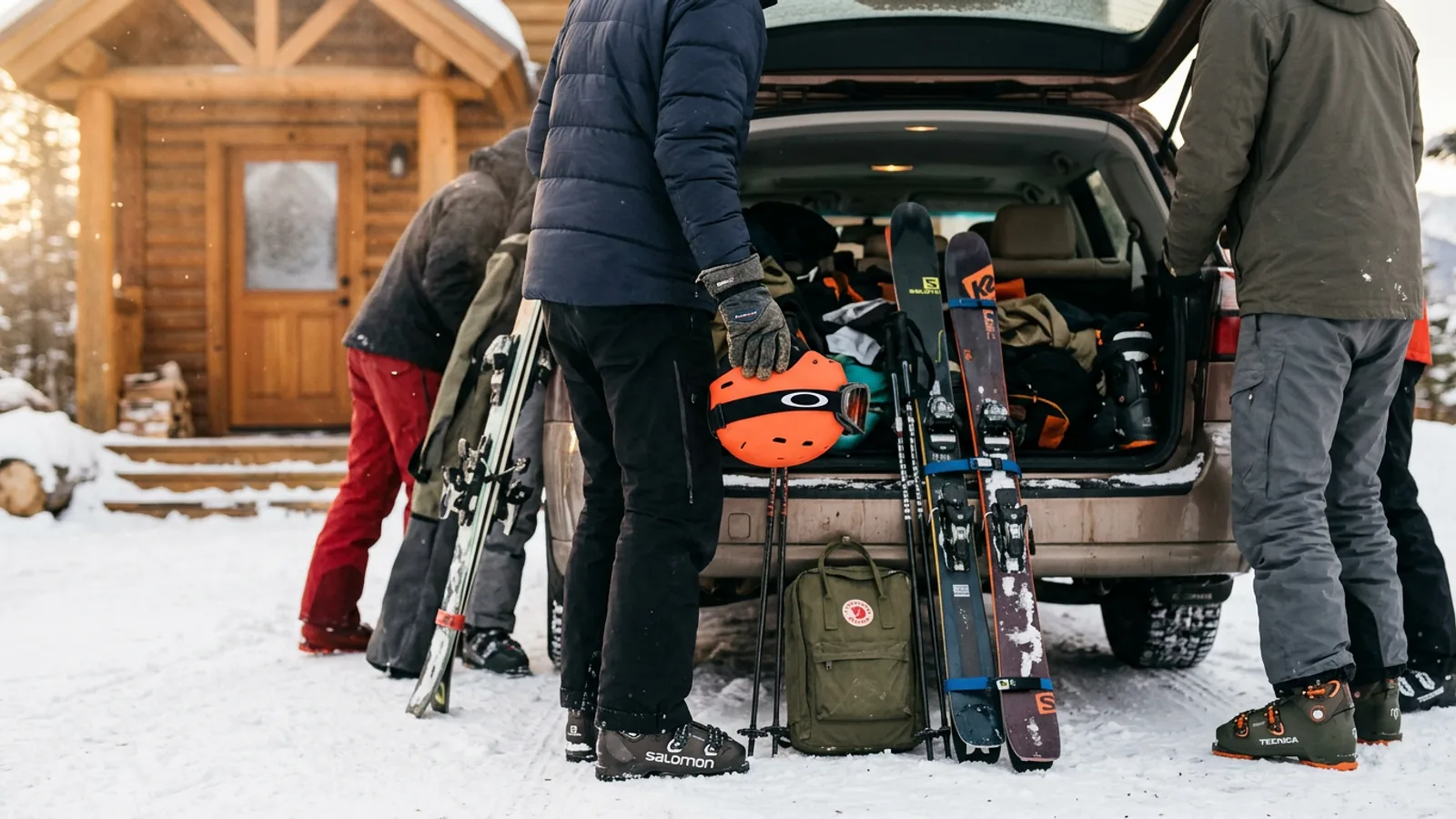
The bottleneck of a group ski weekend
A weekend at a ski resort in the Pyrenees or in Sierra Nevada for six people, in mid-season, usually costs between 1,200 and 1,800 euros if you travel by shared car and rent an apartment. So far, a figure anyone can confirm by checking a search engine. The problem begins when that block has to be broken down into line items with different logics: the lift pass is paid per head and per day skied, the petrol is paid per trip and kilometres, and the accommodation is paid per night booked regardless of who sleeps there sooner. Three units of measure that don't fit together. If you put them all in the same bucket and divide by six, someone is going to overpay.
The most typical case: there are six of you, two don't ski (they tag along, read, go up to the viewpoint), one skis only two of the three days and the other three ski all three days. If I split the lift pass equally among six, the two who don't ski are subsidizing the three who do. If I split the accommodation by nights slept, one of them leaves on Saturday afternoon and the Saturday night is left empty: do I pay it, since I'm staying, or do all six pay it because it was already booked? The arithmetic seems minor but, multiplied by the fatigue of the trip and by the social fatigue of asking for accounts in a group that cares about each other, it's enough to sour the Monday.
Why the Spanish-style split fails in the snow
The Spanish-style split —I put the bill down, divide it among us, done— works acceptably well at a dinner, where everyone consumes roughly the same and the difference between the one who had wine and the one who didn't is offset by the one who had dessert. On a ski trip that symmetry disappears. The difference between skiing three days straight and not skiing at all is easily 200 euros per person in lift pass and equipment rental. Pretending the difference dilutes into shared living is romantic and expensive.
The other source of friction is the time lag. The accommodation is booked three months in advance and often paid by just one person with their card. The lift pass is bought the first day at the ticket office, on separate lines, and each one pays theirs or not. The petrol is paid during the journey, at two fill-ups, by whoever's driving. When Sunday night comes and someone says the dreaded words —let's settle the accounts—, half the group has already forgotten what they paid and the other half remembers wrong. You need a system, not a conversation.
Three blocks with different logics
1. The lift pass and the equipment: strictly by use
A full-day lift pass at a large resort in the Pyrenees or Sierra Nevada moves around 50 to 65 euros in mid-season, and rises to 70-75 on holidays. Equipment rental adds 25 to 35 euros a day. This means a full day of skiing, not counting food, is already 75-100 euros per person. Multiplied by three days, that's 225-300 euros the non-skier shouldn't pay under any circumstances.
The rule for this block is transparent: each one pays for what they ski. If three members of the group ski all three days, one only two and two don't ski, the lift-pass split is strictly individual. The same with equipment. The companion who goes up the cable car as a pedestrian pays their pedestrian ticket and nothing more. Forcing the non-skier to contribute to the lift pass because we're all here together is a way of guaranteeing that companion doesn't come back next year.
2. The petrol and tolls: by kilometres and seats occupied
A Madrid-Sierra Nevada or Barcelona-Baqueira trip runs around 800 to 900 kilometres round trip, with an approximate consumption of 6 litres per hundred and a fuel cost that, with prices strained over the past year by the geopolitical instability affecting oil, easily sits between 90 and 110 euros per car. Adding tolls, we're talking 130 to 170 euros per vehicle for a weekend.
Here the sensible split is by seats occupied and not by the group's total people. If six of you go in two cars —four in one and two in the other— the car with four seats occupied splits its cost among four, not among six. It sounds obvious, but it's common for the six to end up adding the two tanks and dividing by six, which penalizes the one who travelled squeezed into the middle seat against the one who rode comfortably in a car with two people. A reasonable variant: the driver doesn't pay petrol (they pay the wear on their car). It's a convention, not a universal truth, but it holds up if the group accepts it beforehand.
3. The accommodation: by nights booked, not nights slept
This is the trickiest block. Accommodation is booked by nights and paid by nights booked, regardless of who sleeps each one. If you booked three nights and one person leaves before Sunday for personal reasons, the others don't pay that empty bed: the one who booked it pays. It's another matter if the group decides, as a gesture, to take on that cost; but it shouldn't be the default rule.
The correct split is: total accommodation price divided by the number of people who were going to sleep the contracted nights, multiplied by the fraction each one occupies. If all six of you were there all three nights, it comes out equally. If only one stays two nights, they pay two sixths of the total and the other five share the rest. School-level arithmetic, but you have to settle it in writing before leaving, not at the petrol station on the way back.
The invisible problem: the apartment groceries
There's a fourth line item people forget and which in a large group weighs more than it seems: the shopping for breakfast and dinner at the apartment. A group of six over three days easily spends 90 to 130 euros at the supermarket, adding coffee, bread, fruit, pasta, meat for a dinner, wine and beers. If one person goes shopping alone and keeps the receipt in their pocket, that figure evaporates from the split and they absorb it in silence. And if half the group doesn't have breakfast at home because they get up early to catch the first chairlift, the equal split isn't entirely fair either.
The usual solution —and the least bad— is to treat the apartment shopping as a common fund split equally among everyone sleeping there, assuming the small asymmetries of consumption even out over three days. Trying to split a carton of milk and two beers per person is to enter a zone of micro-accounting that devours more relationship than the money it saves.
How to close the split without souring the Monday
The goal isn't to make a perfect split to the cent —impossible, and odious besides— but one that's fair enough in each of the three blocks, that anyone in the group can look at and accept as reasonable. That requires three things: separating the blocks from the start, logging who pays what as it's paid (not at the end), and applying a simple rule to each block.
A tool like ControlarGastos solves this naturally: it lets you create a group, assign each expense a subset of participants (those who ski in the case of the lift pass, those who travel in the case of the petrol, those who sleep in the case of the accommodation), and it distributes the cents by largest remainder, not by truncation, so nobody always carries the rounding. What it returns isn't a magic figure: it returns a matrix of who owes whom, already simplified so the number of final transfers is minimal.
Of the six, two transfers on Monday morning are usually enough to close the account. That's what distinguishes a group that repeats the trip from a group that swears never to coordinate anything again.
Conclusion: the snow is expensive, the friction shouldn't be
A weekend in the snow is already a considerable expense in itself. The bill goes up if the conversation afterwards comes out expensive too, the awkward silences or the group member who feels quietly cheated but doesn't say so. A well-designed split —lift pass by use, petrol by seat, accommodation by night booked, common apartment groceries split equally— cuts the friction at the root. It doesn't eliminate it entirely, because there will always be someone who gets up earlier and has a big breakfast, but it makes it trivial.
The snow, like almost everything done in a group, rewards those who set up the system beforehand and leave the money conversation for the car ride home, when it's all clear and the only thing left is who puts on the music.
Keep reading

Saunas, Escape Rooms, Karting: "One-Off" Fun Among Friends
Occasional 25-40 euros-a-head outings where one person books and everyone else pays later. A look at the ritual of collecting, the apps, Bizum, and why someone almost always ends up forgetting.
Pizza for 6 with 4 Meat-Eaters and 2 Vegans: The Fair Split
The margherita is cheaper than the four-cheese, and the porcini vegan costs the same as the barbecue. Splitting the total six ways looks fair, but it only is if everyone eats the same in value.

Beers at the bar: the phone-calculator ending
Three rounds, eight beers, three plates of patatas bravas, two alcohol-free drinks. The arithmetic at the end can take fifteen minutes or thirty seconds. The difference is in how you model the problem before you order.
Sound familiar?
ControlarGastos automates splitting expenses with your partner, flatmates and friends. Split to the cent, no arguments.
Start for free