Shared-Flat Living Rooms: Furniture for Everyone, No Deeds
Buying the sofa between four sounds easy until someone leaves. Three models so the living-room furniture doesn't turn into a WhatsApp drama full of Bizum screenshots.

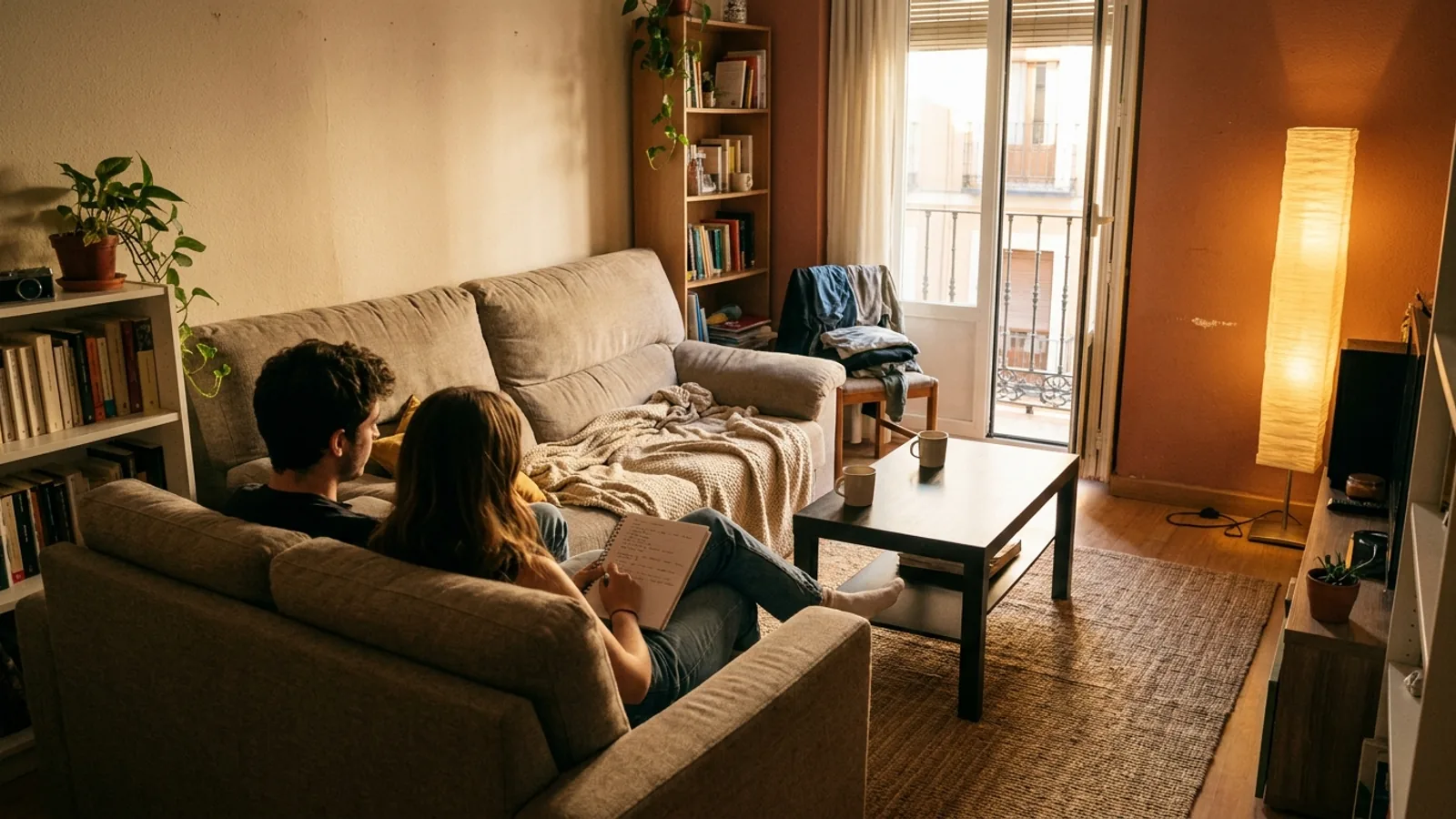
When the sofa weighs more than the friendship
The living room of a shared flat is odd territory. It is the only space where you actually overlap with your flatmates, the place where series are watched, where the Friday drinks happen, where the Christmas tree goes up in December if someone bothers to suggest it. And yet, when the time comes to furnish it, nobody wants to discuss the matter seriously. The typical conversation lasts twenty minutes, ends with "come on, let's just go halves on it", and dies there. Until two years later one of the four moves in with their partner and, suddenly, the sofa is worth money, the low table is worth money, the floor lamp that looked like a joke is worth money, and nobody knows how much.
This happens more than you'd think. A decent dining table from a Swedish chain costs between 250 and 400 euros. A three-seater fabric sofa, nothing fancy, runs from 500 to 800. A large rug another 150. Curtains, lamps, a shelving unit, and now we are talking about some 1,500 to 2,000 euros that have come out of four wallets in random order over six months, with no receipt kept and no agreement on what happens if someone drops out of the flat. The arithmetic has sorted itself out, badly, while nobody was looking.
Why "equal shares" doesn't survive the first tenant change
The default model is the four-way split. And it works perfectly as long as nobody moves. The problem starts the day one of them finds a job in another city and gives a month's notice. If that day the sofa is a year old, how much is it worth? What was paid for it? Impossible: a used sofa with pizza-grease stains is worth half at most. What it's worth now on the second-hand market? Hard to work out without arguing. Zero? That's what gets said when there's a rush, but it leaves a strange feeling: the one leaving feels they're giving away 125 euros to three people who stay, and the ones staying feel the other never bothered to replace the broken chair.
The thing is, a shared flat is not a commercial company with a deed before a notary. You are not going to draft a co-ownership contract for a 600-euro sofa. But you can't pretend there isn't a latent property problem either. The sensible thing is to choose a model before buying anything, write it down in a simple group document, and apply it the same way every time. Three models cover practically every case.
Three models so you don't end up fighting over an armchair
1. The rotation model: one person buys it and takes it when they leave
The idea is brutally simple. Each big piece of furniture has an owner. Whoever buys it pays one hundred per cent and, when they leave the flat, takes it or sells it and keeps the money. The rest contribute a symbolic monthly rent for the use, which is normally waived if the owner gets tired of the calculation or wants to be domestically generous.
It works very well in flats of three or four people with rapid turnover, the kind of flat where people come and go every nine months for temporary jobs or master's degrees. It has the advantage that ownership is clear from day one: nobody argues about whose the table is, because one person bought it and that's that. The catch is that it requires coordination before furnishing the living room, because someone has to agree to buy the sofa, another the table, another the lamps. If everyone prefers not to drop 600 euros at once, the model collapses.
Concrete example: four people in a flat. One provides the sofa (700 euros), another the dining table plus chairs (400 euros), another the TV and the low unit (350 euros), and the fourth handles curtains, lamps and the rug (350 euros). Each will take their own when they leave. It is somewhat more expensive to keep track of mentally at first, but it generates no shared debt.
2. The depreciation model: linear proration over 24 or 36 months
Here the group buys everything in common and treats each piece of furniture as an asset that depreciates month by month. An 800-euro sofa, depreciated over 36 months, is worth 600 after 9 months, 400 after 18, 200 after 27, and 0 once it hits 3 years. When someone leaves, those who stay pay them their share of the furniture's residual value, not of the original price.
It is the fairest model in accounting terms and the one that best reflects the actual wear. It lets turnover be smooth without arguments, because the figure to settle isn't negotiated, it is calculated. All you need is a spreadsheet or an app that keeps the history of contributions per piece and the purchase date.
A detail that is far from minor: splitting to the cent is where people end up getting angry. If the sofa is worth 433.67 euros today among four, that is 108.4175 each. You have to decide who eats the cent. Any decent system should distribute those remainders by largest remainder, not by truncation, so nobody always pays the rounding on every bill of the year.
3. The "it stays in the flat" model: a frozen common fund
The third route is the most romantic and the most dangerous. The group decides that the living-room furniture belongs to the flat, not to the people. Whoever joins pays their share of what is already there (at an agreed value, usually 50 to 70 per cent of the original price if it is recent), and whoever leaves recovers it from the next person who joins, not from the group.
The beauty of the model is that it keeps a stable living room for years, without each move emptying the house. The fragility is that it depends on always finding a new flatmate willing to drop 400 or 500 euros up front just for some furniture. If the tenant market cools, or if you find someone who joins for only six months and doesn't want to buy anything, the system jams and someone ends up paying the silent bill.
The problem almost nobody considers: the small things
The discussion always revolves around the sofa and the table, the visible objects. But the living room fills up with dozens of small things: a wicker basket, two cushions, a generic painting from a flea market, the remote holder, a blanket, the power strips. All of that easily adds up to 200 to 300 euros over months, bought on impulse by one or another, with no receipt kept, no photo, nothing.
The sensible thing is not to treat it as inventory. The small stuff stays in the flat by default, no settlement. If someone wants to take a specific item because they're attached to it (the painting, the blanket inherited from their grandmother), they say so and take it with no compensation. The rest dies where it was born. Any attempt to draw up a to-the-cent balance of the small objects creates an emotional bill far greater than the value of the objects.
How to automate the tracking without becoming an accountant
The most useful thing is to set up a group dedicated solely to "living-room furniture" from the first month, separate from the everyday-expenses group (electricity, water, supermarket). Each purchase goes in as a shared expense with its date, its amount and the depreciation method the group chose. When someone leaves, you look at the list, apply the agreed depreciation, and the system tells you exactly how much those who stay owe them. This is what a tool like ControlarGastos does: it records the purchase, calculates the depreciation, distributes the cents by largest remainder, and keeps the history even if the group changes members three times.
The part you have to do by hand is the prior political decision. Which model we choose, what depreciation horizon we agree, what happens with the small things. That conversation lasts an hour, you have it one afternoon with beers, and it prevents literally every later fight. Skipping it is what makes a perfectly comfortable sofa end up being the reason two people stop talking.
Conclusion: the living room is a project, not an accumulation
What distinguishes a functional shared flat from one where people end up leaving with resentment is neither the neighbourhood nor the rent nor the food. It is the number of difficult decisions left unmade at the start because they seemed uncomfortable. A living room is furnished in six months but lived in for three years. Taking half an afternoon to agree who owns what, how you work out what it's worth in two years, and what happens when someone moves out, is one of the most profitable time investments you can make in a shared life. It is not bureaucracy. It is the respect owed to the number of hours you will spend on that sofa.
Keep reading
Splitting Wi-Fi in a shared flat when one works from home
The one who works from home uses far more bandwidth and far more router time than the others. The legitimate question is whether that justifies paying more. There are arguments to defend it and arguments to knock it down, and the honest answer sits somewhere odd between the two.
Professional Cleaning vs Splitting Chores: The Calculation
Sixty euros once a month among four flatmates is fifteen a head. The question isn't whether it's expensive: it's how much your Sunday is worth and how heavily chore rotation weighs on shared living.
One person's pet in a shared flat: who pays the extra?
A dog or a cat brings costs that don't show up in the flat's rent: an extra deposit, occasional damage, hair on the shared sofa. Splitting it well keeps the pet from becoming the living room's silent conflict.
Sound familiar?
ControlarGastos automates splitting expenses with your partner, flatmates and friends. Split to the cent, no arguments.
Start for free