Professional Cleaning vs Splitting Chores: The Calculation
Sixty euros once a month among four flatmates is fifteen a head. The question isn't whether it's expensive: it's how much your Sunday is worth and how heavily chore rotation weighs on shared living.

The Saturday of the mop
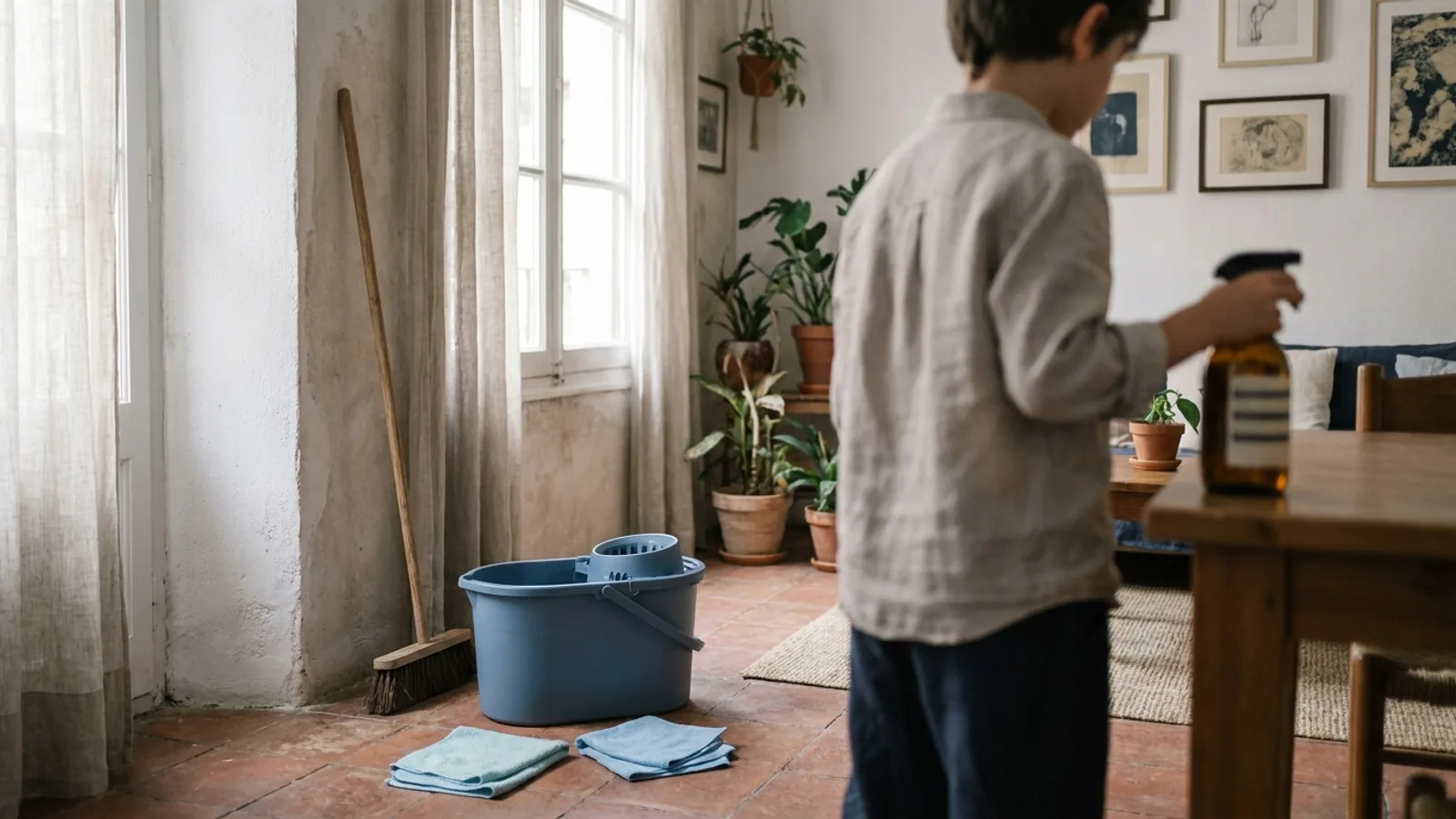
Six-thirty on a Saturday afternoon at the end of the month. One of the flatmates has spent an hour with the mop and bucket, another is scrubbing the bathroom tiles with a latex glove that tore half an hour ago, a third is arguing with the fourth about who said they'd take out the storage-room rubbish before Monday. None of them is particularly happy. They'd all rather be doing something else.
This scene, repeated in four-flatmate flats all over Spain, has an invisible cost: time. And time, in shared living, is the most expensive and worst-accounted-for currency. Deep-cleaning a ninety-square-metre flat can take between three and four hours if it's done properly (kitchen, bathroom, floors, dust, windows); split among the flatmates, that means each one loses a perfectly usable hour of their Saturday or Sunday, once a month.
The obvious question is: is that hour worth the money you save? The less obvious question is: does the shared living gain or lose with the forced rotation of chores?
Why chore rotation wears down
The classic model in a shared flat is rotation: each flatmate has a chore assigned per week, it rotates monthly, and the system works in theory. In practice, rotation has three friction points that erode it faster than it seems.
The first is quality: not everyone cleans the same way. There are those who run the mop as a rite and those who run the mop as a ritual. There are those who clean the bathroom every two weeks with serious products and those who leave it with a superficial wipe. The difference shows within two weeks, and the "which week did you mop, because you can't tell" conversation begins.
The second is compliance: by the third week of the rotation, someone always falls behind. They had an exam, a visit from their parents, a hangover, whatever. They ask to swap the week. The swap is accepted, but the following month that flatmate "forgets" the debt. Then someone keeps the mental tally, and the silent friction begins.
The third is real opportunity cost. An hour of your Saturday scrubbing tiles, if your net hourly wage runs between twelve and twenty euros, isn't just an annoyance: it's time you could have spent doing freelance work, training, or simply resting to arrive at Monday in better shape. That invisible cost almost never enters the cleaning conversation.
Three models for solving the cleaning
1. Professional cleaning once a month
The most obvious model: hire a deep clean once a month from a professional service. In most Spanish cities in 2026, a full clean of a four-flatmate flat runs around sixty or seventy euros, depending on size and area. Among four, that's fifteen to eighteen euros a head per month.
Between cleans, each flatmate maintains their personal area and the light shared maintenance gets done (dishwasher, rubbish, sink) without any formal calendar. The professional deep clean resets the flat once a month and eliminates the long buildups.
Advantages: consistent quality, no compliance arguments, and it recovers between three and four hours of personal time a month for each flatmate. Drawback: it costs real money, you have to be home to let them in, and if anyone in the flat is very private about their room it can create discomfort.
2. Pure chore rotation
The traditional model, with no monetary cost. Each flatmate has an area and a week assigned, and the cycle rotates every month. It works reasonably well in small flats, with flatmates of similar habits and a certain culture of compliance.
The real cost is time: if the rotation includes a monthly deep clean on top of maintenance, each flatmate spends between three and four hours a month on flat chores. Multiplied by twelve months, that's between thirty-six and forty-eight hours a year per person. Almost a full working day of your life.
3. Hybrid model (rotated maintenance, professional deep clean)
It's the most widespread in urban shared flats in recent years, and the one that best balances cost and shared living. The monthly deep clean is done by a professional service (the sixty euros split among four), and weekday maintenance is assigned by rotation: who takes out the rubbish, who loads the dishwasher, who buys toilet paper when it runs out.
Rotated maintenance is light, lasting between fifteen and thirty minutes per flatmate a week, and is perfectly sustainable. The professional deep clean resets the flat once a month to a level of quality you can't reach with amateur rotation. The monthly cost per head, the fifteen to eighteen euros, is comparable to a meal out and buys back an entire weekend.
The calculation almost nobody does
Let's put concrete numbers on the two extreme options. A four-flatmate flat, in a mid-sized Spanish city, with a monthly professional service of sixty-five euros: the cost per head is sixteen euros and twenty-five cents a month. Over the year, a hundred and ninety-five euros per flatmate.
The pure rotation model saves those hundred and ninety-five euros a year, but "costs" between thirty-six and forty-eight hours of personal time per flatmate. If you value your free hour at ten euros (a conservative level), you're saving a hundred and ninety-five to spend between three hundred and sixty and four hundred and eighty in time. If you value your free hour at fifteen, worse.
The calculation, of course, isn't purely monetary. There are flatmates who prefer cleaning to paying, for legitimate reasons: it relaxes them, they take pride in a flat cleaned by themselves, they don't trust outside services in their space. But it's worth doing the math before deciding, because "we'll clean it ourselves" only comes free if time isn't counted.
The conflict that professional cleaning does solve
There's a benefit of the professional model that rarely gets named and weighs more than it seems: it eliminates a source of domestic friction that tends to accumulate resentment. Arguments about cleaning in shared flats are almost never about cleaning: they're about different standards, about the feeling that you do more and others do less, about the tidy flatmate living with a careless one.
When the deep clean is done by someone external, that axis of conflict disappears. What's left (light maintenance) is small and rotational enough not to accumulate grievances. Shared living gets simpler. For many flats, those fifteen euros a month buy peace of mind, not just cleanliness.
How to close it in the flat's system
If the flat decides to hire professional cleaning, the expense goes into the shared account alongside rent and utilities. Any decent shared-expense management system should let you log the recurring monthly charge, split it automatically among the flat's active members for the month (because sometimes someone is away for three weeks and it's worth reflecting that), and show the accumulated annual cost so the renewal conversation is informed. ControlarGastos does exactly that: recurring expense, equal split or weighting by room, and it distributes the cents by largest remainder, not by truncation, so nobody always carries the rounding of the calculation.
The decision to keep or change the model in March or in September is then made with data: how much has been spent, how many times it's been hired, how it's gone. Without data, the conversation is one opinion against another, and the loudest voice usually wins.
Conclusion: time is the flat's real currency
Deciding between chore rotation and professional cleaning isn't deciding whether you spend money or not. It's deciding how you want to spend your time and how much friction you're willing to put into your shared living. Each model has a flatmate profile it suits: rotation works in flats with shared habits, a similar pace of life and a similar culture of tidiness. Professional cleaning works in heterogeneous flats, demanding schedules, or households where minimizing friction is the priority.
What almost never works is deciding nothing. The flat that drags along a rotation nobody honours, without ever having discussed whether it's worth paying, is paying with time and bad mood for a service that could have been outsourced for sixteen euros a month. And sixteen euros a month, given the inflation of recent years, barely covers a decent group dinner anymore.
Keep reading

One person's pet in a shared flat: who pays the extra?
A dog or a cat brings costs that don't show up in the flat's rent: an extra deposit, occasional damage, hair on the shared sofa. Splitting it well keeps the pet from becoming the living room's silent conflict.

Sharing Netflix/Spotify in a flat: the legal grey area
The platforms are tightening their same-household clauses and shared flats live in an increasingly uncomfortable grey area. How to organise the flat's streaming without drama or unexpected cut-offs.

The flatmates' fridge: yoghurts with surnames
The labelling system on the yoghurts, the assigned shelves, the cold war over shared products. The fridge isn't an appliance, it's the emotional thermometer of a shared flat.
Sound familiar?
ControlarGastos automates splitting expenses with your partner, flatmates and friends. Split to the cent, no arguments.
Start for free