Shared flat fibre: what speed if everyone works remotely
When three out of four are on video calls at once, 300 Mbps symmetrical falls short. When it's worth upgrading to gigabit fibre and how to justify it to everyone.

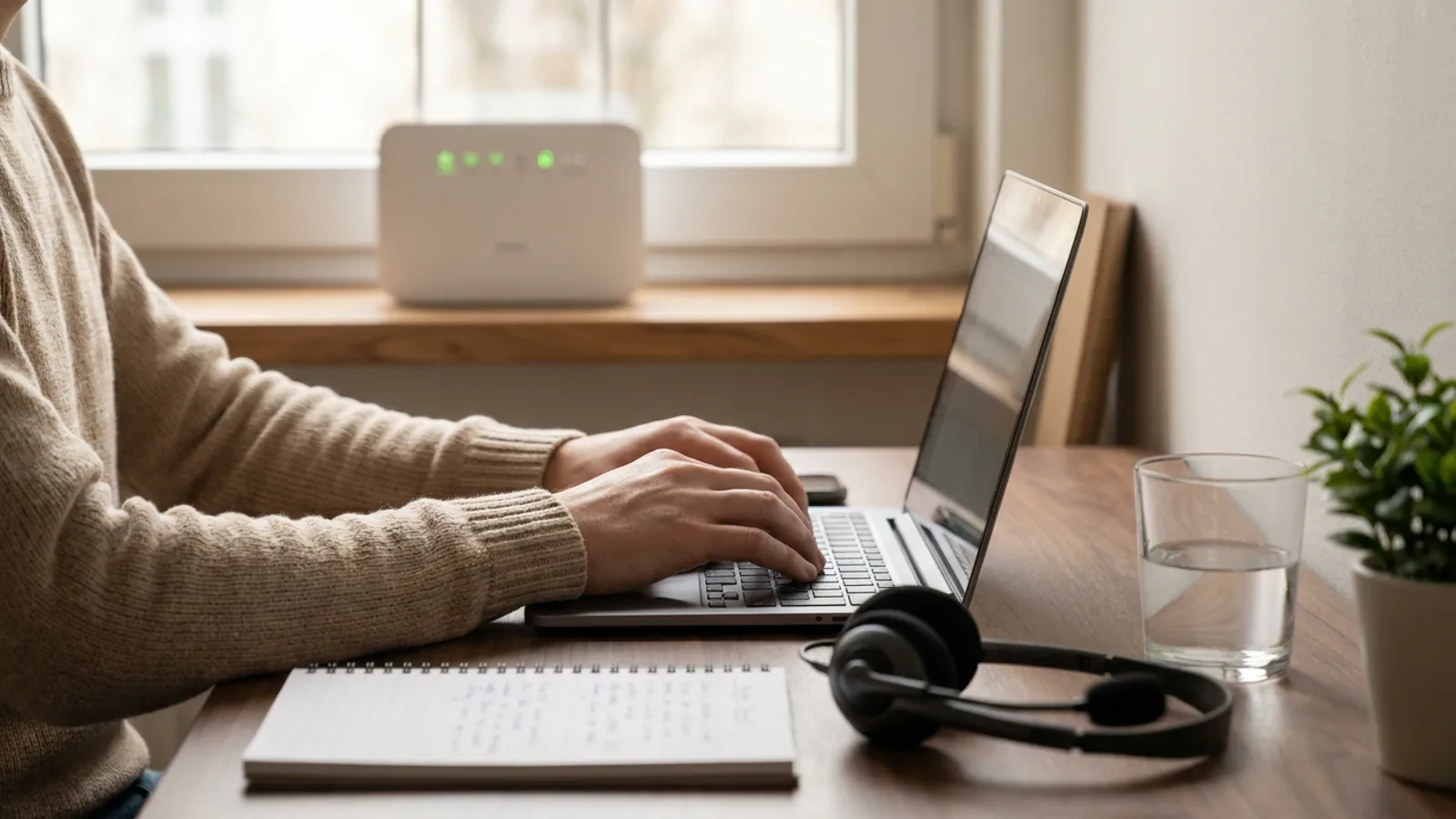
The day the fibre starts to hurt
There is a very specific moment in the life of a modern shared flat when the internet connection turns into a serious problem, and almost no one sees it coming until they live through it. It is the morning when three of the four flatmates are on a video call at the same time, while the fourth downloads an 8-gigabyte operating-system update just because. One person's camera freezes, another's voice cuts out, the third spends the next ten minutes apologising to a client and falling back on their phone's 5G connection while quietly cursing. That scene, which sounds ridiculous, literally happens every single week in thousands of flats from October onwards, when remote work stops being a summer perk and becomes the default winter routine.
The fibre contracted in that flat is probably 300 Mbps symmetrical. It sounds like more than enough. And on paper it is, until you discover that a high-quality video call sustains between 3 and 5 Mbps of upload per person, that the 4-year-old WiFi router the provider left behind loses half its bandwidth passing through a wall, that modern collaboration tools (screen sharing, cloud syncing, project downloads) bite off an extra 50 to 100 Mbps in bursts, and that the combined meter of all four flatmates during peak working hours can demand 400 Mbps symmetrical without blinking. You have come up short without having moved an inch.
Why "300 is plenty" is no longer true in 2026
The convention that 300 Mbps is more than enough for any home dates back five or six years, when the typical use case was "dad watches a series while mum browses and the two kids play games". That world no longer exists in a flat of four working adults. What exists is: two people on near-continuous video calls running heavy tools, one person streaming over lunch, another uploading deliverables to the cloud, someone downloading a 30-gigabyte dataset for a course, two consoles connected on standby, and a dozen IoT devices (thermostat, plugs, robot vacuum) quietly chewing away in the background. All of that, simultaneously, for six to eight hours a day.
On top of this sits a second layer: the nature of fibre quality itself has changed. What used to be a premium service (symmetrical gigabit) is today a commercial offering. The big providers sell 1 Gbps symmetrical for somewhere between 35 and 50 euros a month, depending on the deal. In other words, the price of the 300 Mbps fibre you had in 2021 or 2022 is, today, essentially the same as 1 Gbps fibre. The catch is that the providers don't tell you: you stay on your old contract at 35 euros for 300 Mbps when you could be at 38 euros for 1 Gbps if you only bothered to check.
The calculation that's actually worth doing
1. The real speed, not the contract speed
The first thing, before thinking about changing plans or providers, is to know what speed you're actually getting. The contract figure is what reaches the wall socket. The figure that reaches your laptop at the far end of the hallway is another story. A speed test over a wired Ethernet connection straight to the router at peak hour gives you the realistic floor. A WiFi test in each room tells you whether the problem is the line or the device. If you have 300 Mbps on the contract and a wired test gives you 280, that's fine. If WiFi in your room gives you 60, the problem isn't the fibre, it's the router or its placement.
This matters because switching to 1 Gbps with an old WiFi 5 router is throwing money away: you won't see more than 250-350 real Mbps over the air on your laptop, no matter what the provider charges you. The real investment is the two things together: a higher-capacity line plus a modern WiFi 6 or WiFi 6E router, ideally with a mesh system if the flat is large or has lots of walls.
2. The cold cost-benefit
In concrete numbers. A flat of four goes from 300 Mbps to 1 Gbps for a monthly difference of about 5 to 10 euros, depending on the deal. That's between 60 and 120 euros a year, split among four people. We're talking about 15 to 30 euros per person per year. For someone working from home an 8-hour day, a single hour lost in a month to a connection that fails during an important meeting already pays for the investment on its own. The question isn't whether it's worth it, it's why it wasn't done sooner.
The factor that does deserve some thought is the router. A decent WiFi 6 unit for a shared flat costs between 90 and 180 euros, and a two-node mesh system for a large flat can run to 250-350. That's an investment worth dividing up carefully.
3. Who pays for the equipment and how it's split
The monthly fibre is usually split equally, just like electricity or water. It's the simplest and, unless someone works from the flat all day while the others only come home to sleep, the fairest. The router, on the other hand, is an asset. If one person pays for it, it stays theirs. If the group pays for it, you have to decide what happens when someone leaves. Here, just as with the living-room furniture, it's worth applying straight-line depreciation (24 to 36 months) and treating leaving the flat as settling the residual value. A 180-euro router, after 12 months, is worth 90 euros for the flat's purposes. If someone new moves in, they pay their share of that 90; if someone leaves, they get their share of that 90.
The hidden problem: the asymmetrical speed they're selling you
A lot of commercial gigabit fibre offers in Spain come in a 1 Gbps download / 300 Mbps upload format. For a household of people who only consume content (Netflix, YouTube, browsing) that's perfectly reasonable. For a flat of remote workers it's a hidden con: four simultaneous video calls, cloud uploads, calls with screen sharing, all of that lives in the upload. If the upload is 300 Mbps and it's split four ways, you're back at 75 Mbps per person, which with high quality and modern tools gets tight at peak times.
The fibre that really makes the difference is symmetrical: 1 Gbps both upload and download. Not all providers offer it at the same price, you have to read the fine print. For a flat of remote workers, that difference between 300 and 1,000 Mbps of upload is, frankly, what determines whether the connection lets you work in peace or whether you spend your winters apologising to clients and bosses.
How to handle the change without anyone complaining
The technical decision is relatively easy. The human part is what usually gets it stuck. The clean approach is to raise, just once, a short conversation: "folks, this is what we pay today, this is the new offer, this is the monthly difference per head, shall we go for it?". If all four are working from home, the yes is practically automatic. If there's someone who only comes home to sleep, it's worth asking whether they want to take part fully in the split or take on a smaller percentage, acknowledging that they use less bandwidth. That adjustment, written down in the group, prevents resentment six months down the line.
Then you have to automate the tracking. If you pay shared bills for internet, electricity, water and cleaning, it's worth having them all in the same digital shared-expenses group, with an automatic monthly charge and a split down to the cent. Any decent system should give you a monthly record of the bill, division among the flatmates (proportional for couples or equal shares), and a split to the cent by largest remainder when the amount isn't divisible. ControlarGastos does exactly that, without anyone having to keep a notebook by hand.
Conclusion: fibre is the new electricity
For a long time the conversation about internet in shared flats revolved around whose name it should be in and whether the megabits were enough to watch films. In 2026, with most young professionals alternating between office and home at least two or three days a week, fibre has stopped being a leisure service and become critical infrastructure for your working life. Upgrading it, modernising the router and splitting the cost fairly isn't an extravagance. It's exactly the same decision the previous generation made when they stopped heating the house with butane and switched to natural gas: the question isn't whether it's time, it's how much longer you're going to keep pretending the old model still works for you.
Keep reading

Splitting Wi-Fi in a shared flat when one works from home
The one who works from home uses far more bandwidth and far more router time than the others. The legitimate question is whether that justifies paying more. There are arguments to defend it and arguments to knock it down, and the honest answer sits somewhere odd between the two.

Professional Cleaning vs Splitting Chores: The Calculation
Sixty euros once a month among four flatmates is fifteen a head. The question isn't whether it's expensive: it's how much your Sunday is worth and how heavily chore rotation weighs on shared living.

One person's pet in a shared flat: who pays the extra?
A dog or a cat brings costs that don't show up in the flat's rent: an extra deposit, occasional damage, hair on the shared sofa. Splitting it well keeps the pet from becoming the living room's silent conflict.
Sound familiar?
ControlarGastos automates splitting expenses with your partner, flatmates and friends. Split to the cent, no arguments.
Start for free