The kids' dentist bill: braces and check-ups
Children's orthodontics runs around 2.500 to 4.000 euros per child and adds to fillings, check-ups, and emergencies. A calm look at how to fit that expense in without the family budget coming apart.

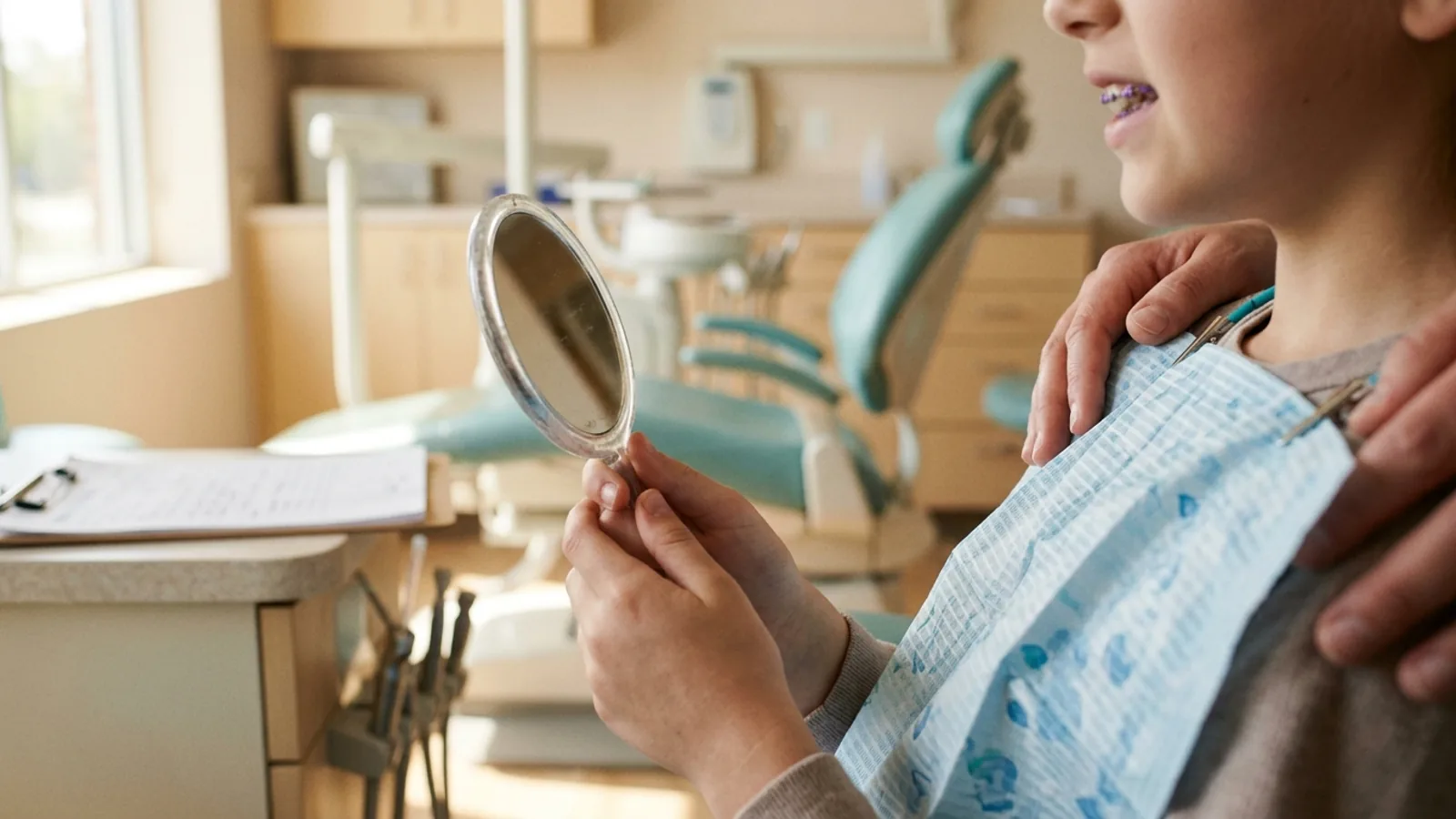
When the dentist says the word "braces"
The first time the paediatric dentist says, in that neutral voice dentists have, "we're going to have to consider braces in a couple of years," most parents nod as if we knew what that means. We nod, pay for the check-up, head out onto the street with a kid sporting fresh fluoride and, back in the car, someone says quietly: hey, and how much is that going to cost?
The short answer, in the Spain of 2026, is between 2.500 and 4.000 euros per child. The long answer depends on whether we're talking about interceptive orthodontics (the first phase, while there are still baby teeth), fixed braces with metal brackets, aesthetic brackets, clear aligners, retainers afterwards, and on how many emergencies you'll have over a bracket that comes loose on a Sunday night. To that you have to add the invisible routine: two check-ups a year, a cleaning when it's due, the odd filling on a permanent molar around the age of seven, and the lottery of the first wisdom tooth if it comes in crooked.
The dental bill isn't an event. It's an infrastructure. And like all family infrastructure, it's worth treating it as such: with planning, with the numbers on the table, and with an honest conversation between the two adults of the household.
Why the pay-when-it-hurts model doesn't work
The strongest temptation, especially when the budget is tight, is to muddle through. Go when it hurts. Go when you can't put it off any longer. It's understandable, but economically it's the worst possible option. A timely filling costs between 60 and 90 euros. A root canal, when that filling has turned into a cavity that reached the nerve, costs between 200 and 400 euros. A crown afterwards, if the root canal has left the tooth too weakened, another 400 to 700 euros on top. The bill grows almost cartoonishly.
With braces the effect is similar, though slower. A malocclusion detected at age seven can be treated in a short, cheap first phase, leaving the second phase (with permanent teeth in place) lighter. If that first phase isn't done, you arrive at age twelve with a more complicated, longer, and more expensive case. Not always, but in a high enough proportion for the decision to be clear: dental prevention isn't a whim, it's the cheap version of the problem.
Three ways to finance the treatment
Let's start from a typical case: two children, aged nine and eleven, both with an indication for braces. The clinic gives you a combined estimate of 6.500 euros, spread over three years. There are three reasonable paths.
1. Instalment payment at the clinic itself
Most private clinics in Spain offer interest-free instalments, usually over 24 or 36 payments. In the example of the 6.500 euros, that's about 180 euros a month for three years. The advantage is transparency: no external lender, no paper signed with anyone but the clinic, no risk of a late payment showing up on a defaulters' register. The downside is that you depend on the financial health of that particular clinic. If it closes mid-treatment (rare but it has happened), the payment continues, the treatment doesn't.
Practical recommendation: ask for the estimate broken down by phases, not by months. If the estimate says "36 payments of 180 euros" with no detail, ask for the breakdown by clinical milestone (placement, check-ups, removal, retainers). That protects you in case you change clinics.
2. Dental insurance with orthodontic coverage
Dental insurance has matured quite a bit. A family policy with orthodontic coverage runs between 18 and 28 euros a month per person, and tends to cut the treatment cost in half or more, with co-payments per procedure. For a family of four, the annual premium runs between 900 and 1.300 euros, and the savings accumulated over a three-year span with two active orthodontic treatments can comfortably offset it. You have to read the small print: most require a waiting period of six to twelve months before covering long treatments, and almost all exclude treatments already started. Taking out the insurance the month the dentist says the word braces is already too late.
3. Earmarked consumer loan
The least advisable option except in an emergency. A personal loan over 36 months for 6.500 euros, at a nominal rate of 7%, means payments of about 200 euros a month and an accumulated financial cost of around 700 euros. In other words, you pay 10% more for the same mouth. It only makes sense if the clinic doesn't offer instalments and if the clinical urgency doesn't allow waiting until you have insurance.
The invisible spending: check-ups, emergencies, and supplies
Beyond the headline of braces, there's a silent drip that eats up around 300 to 500 euros a year per family. Two routine check-ups per member (40 to 60 euros each), one cleaning a year from age twelve (50 to 80 euros), a permanent-molar filling every so often (70 to 100 euros), the night guards if someone clenches their jaw at night, the mouthguards if the kid plays rugby or hockey. All of that appears in small amounts that don't seem like much one by one, but add up.
To that you add the specific home supplies: interproximal brushes for the brackets, a water flosser, floss with a threader, orthodontic wax for minor emergencies, prescription fluoride rinse. Another 100 to 150 euros a year, with no big shocks but constant.
How to close it out without the split becoming an argument
What nobody tells you about the kids' dentist bill is that it's almost always paid by just one of the two adults, usually the one who physically takes the child to the appointment. That, multiplied by thirty-six appointments over three years, creates an invisible imbalance that doesn't come up in any conversation until it comes up in a bad one. That's why it's worth treating this expense exactly as we treat the mortgage or the rent: as a fixed family line, not as an unexpected cost.
What a couple or a family needs to manage this well is a system that records each payment the moment it happens, associates it with the right child, categorizes it as health, and at month's end tells you who fronted what and how much the other needs to transfer to settle up. That's what a tool like ControlarGastos does: each payment at the clinic goes in as a shared expense, gets split according to the rule the couple has agreed on (50-50 or proportional to income), and it splits the cents by largest remainder, not by truncation, so nobody always pays the rounding. The conversation stops being "you paid last time, it's your turn" and becomes a net balance at the end of the month.
Conclusion: the children's oral health is a ten-year project
The dentist bill doesn't end with the last bracket removed. It ends, if it's done well, with two teenagers who have fixed lingual retainers, who know how to use the water flosser, and who understand that looking after their mouth is one of the few things their future money will thank them for. Framing it as a three-year expense, financed with judgement, split without friction between the two adults of the household, transforms an intimidating bill into an infrastructure that sustains itself. And that, in the end, is what distinguishes a mature family economy from one that just keeps putting out fires.
Keep reading

Saving for Your Children: A Joint Piggy Bank That Lasts
Building a financial cushion for your children calls for decisions made with an 18-year horizon. An account for when they turn 18, an index fund in their name, or a classic piggy bank: how to decide, how much to put in, and why not to give up halfway.

A Fair Split When One Partner Is on Sick Leave
A long sick leave cuts income to 60-75 percent of the salary for months. Renegotiating the contribution to the shared pot is an uncomfortable conversation that few couples have in time. Here's a guide to having it without waiting for the first unpaid bill.

Blended family expenses: children from past relationships
Children from the first marriage, children from the new partner. Child support going out, child support coming in, child-specific expenses and shared ones. The arithmetic of affection in blended families demands clarity before generosity.
Sound familiar?
ControlarGastos automates splitting expenses with your partner, flatmates and friends. Split to the cent, no arguments.
Start for free