Individual electric vs. central heating: the split changes
A heat pump in every room looked like total freedom. Until the electricity bill arrives and you discover that the cold-blooded one at the end of the hall has wiped out everyone's budget. Rules for not falling out in February.

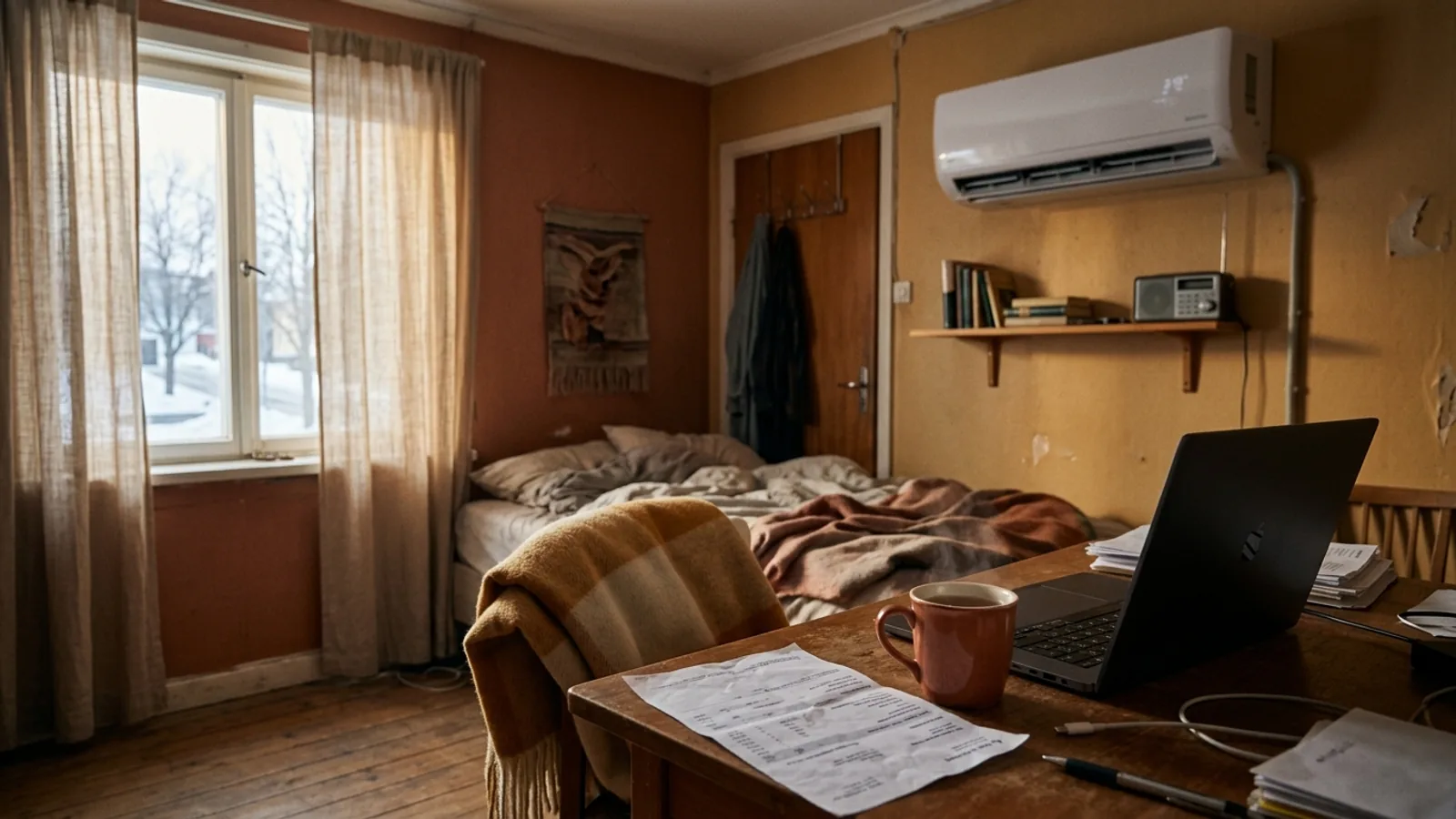
The winter the back bedroom became a problem
The day a shared flat installs a heat pump in every bedroom, everyone applauds. At last nobody has to argue about whether or not to turn on the central heating. At last the person who sleeps with the window cracked open can have their personal icebox while the one who feels the cold at the end of the hall runs a private sauna. At last, freedom. That lasts roughly until the first February electricity bill arrives.
What looked like a leap forward in flat-sharing suddenly turns into an awkward conversation. The bill has gone from the usual 90 euros a month to something edging dangerously close to 280, and splitting it 50/50 between the two tenants, or in thirds among the three, is no longer a matter of indifference. Because not everyone heated equally, not everyone had the pump cranked to 24 all day, not everyone was away from the flat for a fortnight on work. And even though nobody wants to be everyone else's accountant, someone is going to bring it up. The question is whether they'll bring it up in time, with a system, or whether they'll bring it up when they're already fuming.
Why electricity splits badly by default
Domestic electricity in a shared flat has an uncomfortable property: it's invisible and very unevenly distributed at the moment of use. The fridge consumes roughly the same for everyone, the washing machine too, the lights don't move the needle. But electric heating, especially from a heat pump or resistive radiators, can multiply a home's baseline consumption by five or six. And that consumption is completely tied to a specific person, a specific room, and a specific schedule. Splitting that bill the way you split the internet subscription or the cooking oil is exactly the opposite of a fair split.
The other trap is the tariff type. On time-of-use tariffs, an hour of heat pump at eleven in the morning costs more than double the same hour at four in the morning. If one person in the flat works from home in winter and another is at an office until six, the first is consuming almost everything in the expensive band. If everyone pays equal shares, the person who was out of the flat ends up subsidizing the thermal comfort of the one who stayed in. There's no bad faith here, it's simply that the equal-shares split model accounts for none of this. And everything a model doesn't account for, the household pays for in friction.
Three rules for splitting electricity when there's individual heating
1. Shared baseline and usage-based surplus
The first rule, and the easiest to explain to a new flatmate, is to split the bill into two layers. A shared layer covering the flat's estimated baseline consumption (fridge, lights, washing machine, hob, shared appliances, router) and a variable layer assigned to each person's individual use of heating and air conditioning. The shared layer is split in equal parts. The variable layer is split by actual use, ideally measured with individual smart plugs on each heat pump, or estimated by declared hours if nobody wants to install anything.
A numerical example helps. If February's bill comes to 260 euros and the baseline consumption in a mild month is estimated at around 110, the remaining 150 euros are split according to each room's heating use. If three people live in the flat and the plugs have logged 180 hours in one room, 120 in another, and 60 in the third, the 150 euros are split in proportion 180/120/60, that is, 75, 50, and 25. Each person pays their share of the 110 shared plus their share of the extra consumption. And split the cents by largest remainder, not by truncation, so the person with the least use doesn't always end up paying everyone else's rounding.
2. Flat seasonal quotas
The second rule sidesteps the technical problem of measuring actual use, at the cost of some averaging. It means agreeing at the start of winter on a flat monthly heating quota for each tenant, based on room size, orientation, and declared habits. Someone with a large room facing north who works from home pays, say, 60 a month during the three cold months. Someone with a small interior room who's out all day pays 25. The shared bill is reconciled at the end of winter and the gaps are settled. The virtue of this model is predictability: nobody gets a nasty surprise. The weakness is that it requires everyone to be honest when declaring their habits, and that doesn't always happen.
3. Time-of-use tariff with an agreed shared schedule
The third rule changes the problem instead of solving it. If the flat's electricity tariff has time-of-use pricing, you can agree that the heating only comes on during the cheap band, except for declared one-off cases. You bring the conversation's thermal insulation down to an operational agreement: pumps on between 22 and 8, with programmed timers, and radiators off during the day unless someone is working from home, in which case that consumption is charged to them individually. It's the most engineering-minded model and often the most effective, because it turns the split into something almost automatic: since nearly all the consumption falls into the cheap, shared-use band, the bill doesn't blow up and the imbalances dissolve.
The problem of the one who's away for a fortnight
There's a variable no simple model covers and that, in young shared flats, happens all the time: the person who leaves. It might be for a work trip, for going back to their parents' village over a long holiday, for a breakup that keeps them away for half the month. When a tenant spends a significant chunk of the month out of the flat and the others keep heating, splitting the bill as if nothing happened is unfair. The practical rule that works best is to declare long absences (more than five days in a row) and discount those days from the shared-use count. There's no need to get down to the cent, it's enough for the system to acknowledge that person wasn't there. This layer is almost always forgotten and it's the one that breeds the most resentment, because the person who was away feels they've paid twice (their trip and the heating they didn't use), and the person who stayed in doesn't understand why they're being charged more after the fact.
How to close the account without falling out
The operational problem with any of these models isn't the model itself, it's the settlement. Having to sit down at the end of the month with the bill, the timers, the absences, and the calculator is exactly the situation no shared flat survives for more than two months in a row before someone lets it slide and someone else remembers it with resentment. What you need is a system that allows expenses with unequal percentages, records who paid the shared bill, applies the agreed quotas, and shows, without debate, how much each person owes whom. This is what a tool like ControlarGastos does: it translates the start-of-winter agreement into an account book that updates itself, and it eliminates the kitchen conversation in March when everyone is worn out from the cold.
Conclusion: thermal comfort is individual, the bill isn't
Individual electric heating is a genuine improvement for living together, but only if the splitting model is updated at the same pace as the technology. Keeping a 50/50 split with independent heat pumps is like having three cars and paying for the petrol between everyone: someone is going to come out worse off and, worse still, someone is going to take advantage without meaning to. Agreeing on the model at the start of autumn, before the first cold snap, avoids the awkward February conversation. And signing it off in a shared system, where anyone can check the rules, means that the conversation, if it comes, is about the numbers, not about who feels the cold most.
Keep reading

The flatmate who comes home late: noise, lights, heating
There's a financial cost to living with someone on a night-owl schedule that almost no one quantifies. Heating at three a.m., lights on all night, a shower at five. When it's fair to renegotiate the flatshare's contribution.
Lift fee on a top floor: pay the surcharge or not?
In many shared flats there's an extra community fee for using the lift. Who pays it, whether it goes into the shared pot, and what the law says. A practical guide so you don't end up arguing every month with whichever flatmate is on duty.

Skipping Cleaning Turns: Should It Mean Paying Up?
Whoever doesn't clean pays whoever does. It sounds radical, but it's one of the few models that actually works in shared flats where someone always ends up doing more. How to apply it without it feeling like a disguised employment contract.
Sound familiar?
ControlarGastos automates splitting expenses with your partner, flatmates and friends. Split to the cent, no arguments.
Start for free