Splitting group dinners: the endless round
Going fifty-fifty, splitting literally, or reaching for the calculator are three different protocols for the same dinner. Here's when each one is worth using and why there's always someone who loses out.

Dinner as a distributed system
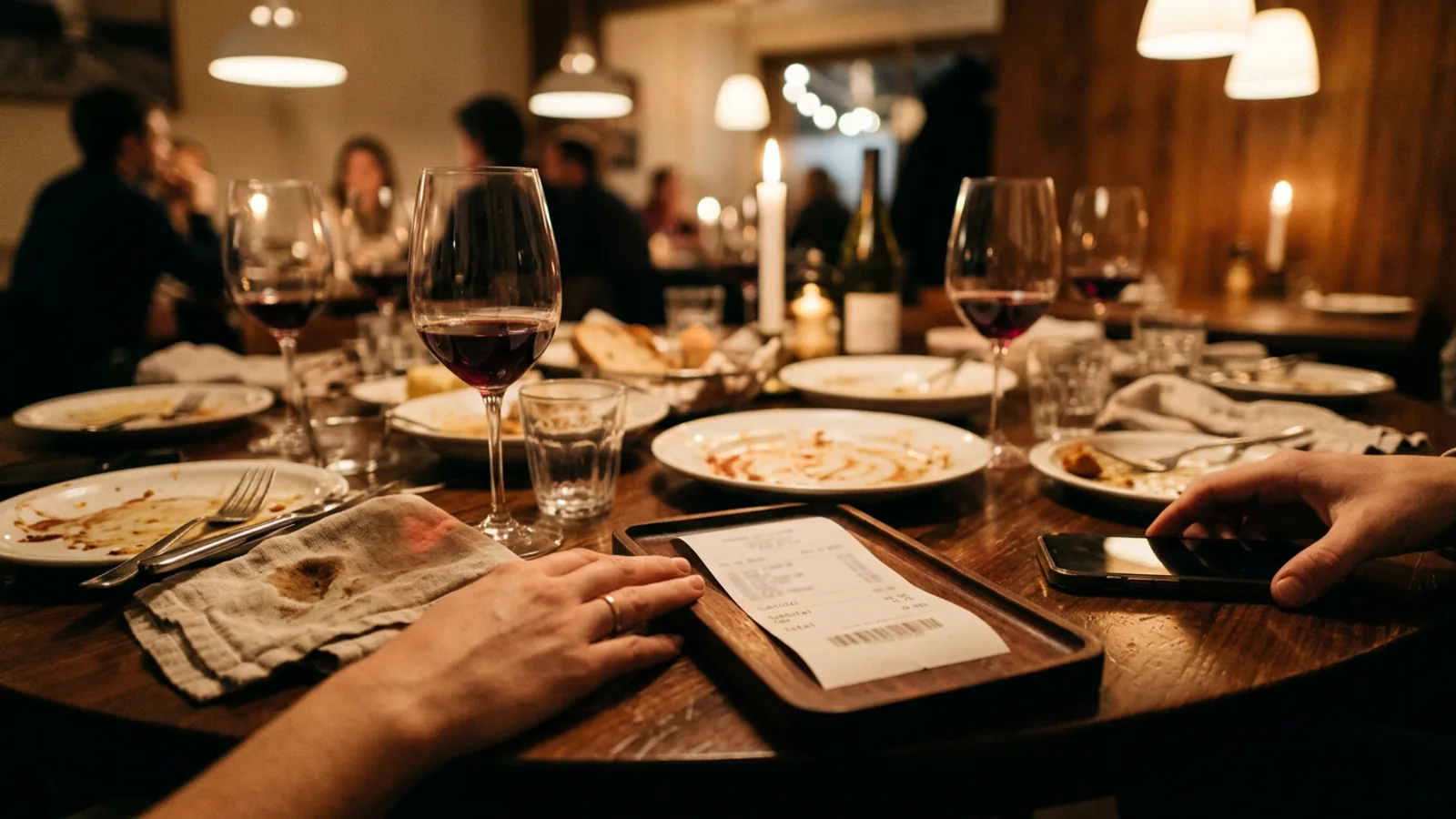
A group of eight friends arrives at a restaurant on a Friday night. The usual happens. Two share a bottle of wine, one orders a wildly expensive burger with an extra side, another just picks at a couple of plates, someone else came by car and is drinking water. When the bill arrives, someone says "come on, let's split it eight ways", and the whole table nods with that mix of haste, relief, and faint resentment that defines group splits.
Put less tenderly: the group is applying a cheap consensus protocol to avoid paying the cognitive cost of a fair one. It's perfectly rational when the amounts are small and the deviations are too. It stops being so the moment the spread between what each person has consumed exceeds a certain threshold, which for a typical 2026 urban dinner sits somewhere between twelve and fifteen euros a head. From there, the egalitarian model starts transferring money from those who consume little to those who consume a lot, an eternal round that closes over the same four people year after year.
This article isn't about playing the victim of whoever orders less. It's about choosing the right model for each dinner and knowing when that model breaks. People who organise groups know that the split is a process-engineering problem disguised as social etiquette.
Why "50/50" is a shortcut, not a rule
The egalitarian model has one huge advantage: it costs nothing to manage. The bill lands, someone does a division, the payment-app transfers go out in forty seconds, and nobody has to look at the receipt. In a group where everyone consumes roughly the same, equalising is optimal. The mistake is applying it by default to groups where consumption is notoriously unequal.
Two asymmetries break the model every time. The first is alcohol. A bottle of wine with glasses, or a couple of cocktails, push one person's bill twenty or twenty-five euros over the average. If there are two non-drinkers at the table, they're systematically subsidising everyone else's after-dinner drinks. The second is restrictive diets. Whoever eats vegetarian at a meat-heavy place usually pays half as much for their dish and finds themselves absorbing the cost of someone else's sirloin. The frequency with which this happens means that, in stable groups, the same two or three lose out dinner after dinner.
It's not a drama if it happens five times a year. It is if it happens forty. And consolidated groups of friends meet up far more often than they remember.
Three protocols and when to use each
1. Literal split by consumption
Everyone pays for what they ordered. The restaurant's itemised bill is reviewed, dishes are assigned to people, shared plates are divided among whoever ordered them, and it's all totalled up. It's the fairest model and the most expensive to manage.
It works well when the group is small —four or five at most—, when there's a clear deviation between consumptions, or when there's one person in the group who'd rather take on the friction of doing the maths than the friction of feeling they're paying too much. It fails in big groups because the manual management becomes endless and because the rounding to the cent, repeated dinner after dinner, always ends up favouring whoever's holding the calculator.
An example. Dinner for six. The total bill is one hundred and eighty-four euros twenty. Two people share a plate of croquettes and half a bottle of white wine. Another person orders just an individual pizza and water. The other three share two meat dishes and a bottle of red. The literal split requires breaking the bill into blocks: the wine-and-croquettes block is divided between two, the meat-and-red block among three, the pizza is paid by its person. Done by hand it takes ten minutes. Done in a tool, thirty seconds.
2. Equalising by blocks with a correction for drinks
A middle-ground model. All the food is divided equally and the drinks are assigned literally. It's the one that fits best in medium-sized groups —six to ten people— where the diet is relatively homogeneous but the alcohol consumption isn't.
The logic is that food at a group dinner is ordered to share or evens out over the year ("today I order the sirloin, tomorrow someone else does"), but drinks are individual and persistent: whoever doesn't drink alcohol, doesn't drink alcohol. Assigning each drink to its consumer closes the biggest asymmetry without forcing you to itemise every dish. It's fast and captures between eighty and ninety per cent of the fairness of the literal model.
3. The group's shared kitty with a persistent balance
For consolidated groups that meet up often. Instead of squaring up each dinner, the group keeps continuous accounts where each dinner adds debt and credit to each person. Whoever pays today's bill ends up with a positive balance; whoever hasn't paid anything in two months, with a negative one. Every now and then the settling-up transfers are made.
This model is optimal when the group meets more than six times a year and the amounts are significant. It reduces the number of payment-app transfers and puts the focus on the net balance, not on each individual operation. The condition for it to work is that the accounting is centralised and visible to everyone. If it lives in one person's head alone, it breaks the day that person gets tired of it.
The hidden problem: the organiser
There's a fourth variable nobody adds up and that decides more dinners than it seems: the invisible cost of organising. Whoever books the table, proposes dates, sends reminders in the days before, pays the whole bill with their card, and then chases the payment-app transfers is doing real work. In a group of eight, that person tends to always be the same one. And most split models don't recognise that work.
It's not about paying the organiser —that would be absurd and would undermine the spirit of the group— but about the system not adding extra friction for them. If, on top of organising, they have to chase payments, keep the tally in their head, and put up with "sorry, I'll send it over" for three weeks, the group is levying a silent tax on them. Sooner or later they stop organising, and nobody understands why the dinners have grown further apart.
How to automate the boring part
The dinner itself —the conversation, the place, the moment— is the only thing that isn't automated. The split is. Any decent tool should let you create a persistent group, log each dinner with who paid and who consumed, manage partial payments, and always show the net balance among everyone. This is what a tool like ControlarGastos does: a dinner is logged in under a minute, the drinks are assigned individually, the shared plates are split among whoever consumed them, and it splits the cents by largest remainder, not by truncation, so nobody always pays the rounding.
What matters about centralising it isn't saving time, but taking the accounts out of the conversation. When the group knows the balance is visible, the "I think I paid that time" arguments disappear, replaced by data. And that transparency lowers the cost of meeting up, which translates into meeting up more.
Conclusion: the group's fairness is a decision, not an accident
Friendships survive almost anything except the resentment that accumulates in silence. The group dinner is one of the few social rituals where money, diets, consumption habits, and generosity meet at the same table, and there's no way to stop that intersection from generating friction. What you can stop is the friction staying inside.
Explicitly choosing a split model at the start of the group —and revising it if circumstances change— is a small, boring act that protects the quality of the friendship far better than any speech. Friendships that last decades tend to have behind them, hidden away, a silent protocol nobody has verbalised but everyone respects. Verbalising it doesn't take the charm away: it adds to it.
Keep reading

Beers at the bar: the phone-calculator ending
Three rounds, eight beers, three plates of patatas bravas, two alcohol-free drinks. The arithmetic at the end can take fifteen minutes or thirty seconds. The difference is in how you model the problem before you order.

One person's pet in a shared flat: who pays the extra?
A dog or a cat brings costs that don't show up in the flat's rent: an extra deposit, occasional damage, hair on the shared sofa. Splitting it well keeps the pet from becoming the living room's silent conflict.
The friend who always pays less: bring it up or stay quiet?
In every group there's one who orders the cheapest thing, leaves early or pays the bare minimum. How to spot the pattern, when it's worth bringing up and when it's better to accept it as system noise.
Sound familiar?
ControlarGastos automates splitting expenses with your partner, flatmates and friends. Split to the cent, no arguments.
Start for free