Roomies with separate pantries: the zero-split experiment
Everyone buys their own, cooks their own and pays for their own. On paper it sounds flawless. In practice, zero split has hidden costs no roomie tells you about until the third month.
The everyone-for-themselves utopia
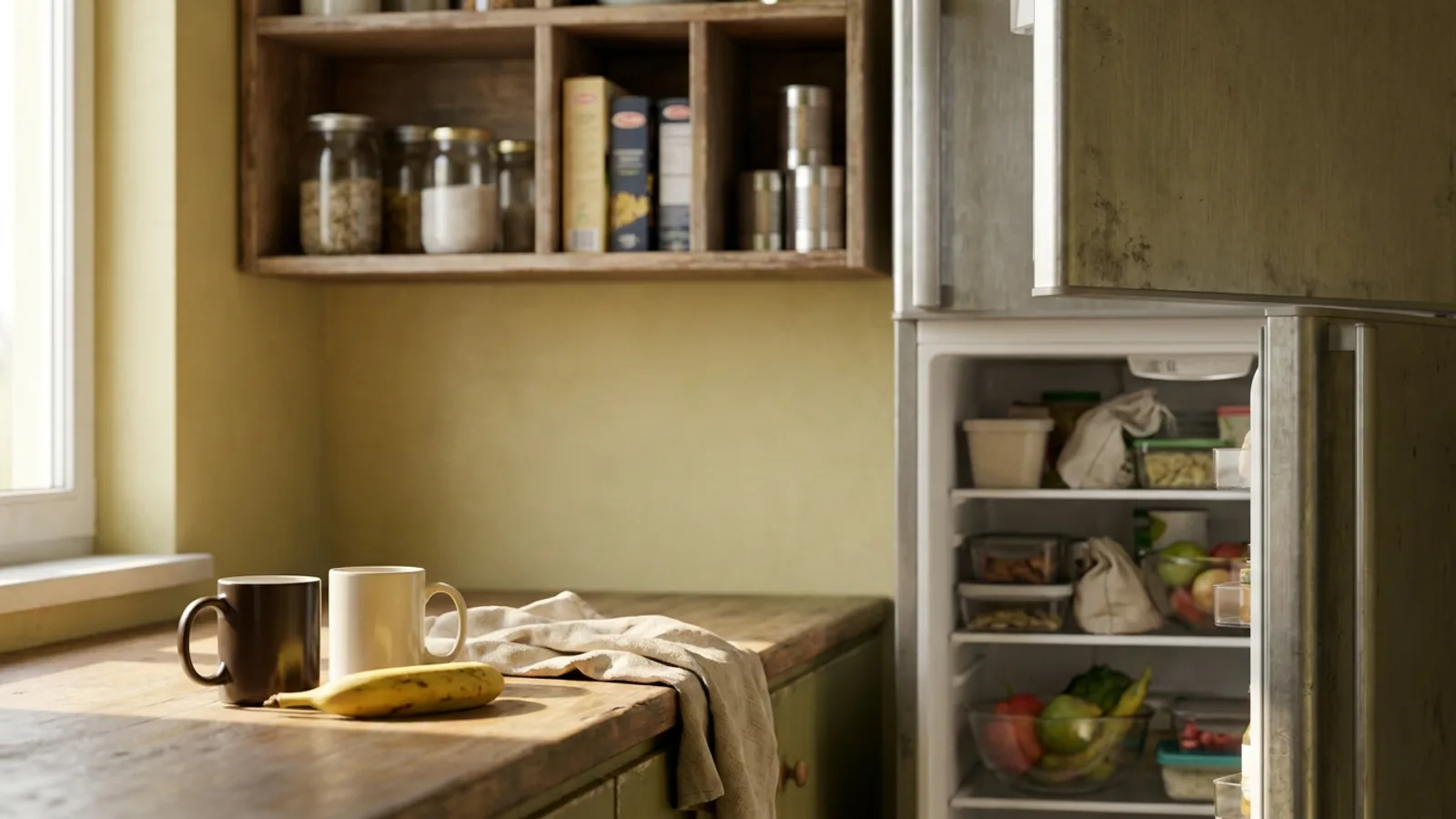
The first time I heard about the "zero split" model was in a shared flat in the Lavapiés neighbourhood where four people had decided they wouldn't share absolutely any food. Each had their own shelf in the fridge, their own drawer in the pantry, their own cutting board and, in one particularly engineer-minded case, their own frying pan marked with masking tape. The idea was clear: if nobody eats the other's stuff, nobody argues. The friction of splitting is eliminated because there's nothing to split.
I tell it because, on paper, the model is elegant. It reduces negotiation to zero, avoids the classic drama of "who finished the cheese?" and simplifies the accounts to a single shared item: rent and utilities. Everything else is individual responsibility.
What nobody tells you when you move into a flat like this is that, after three months, invisible costs start to appear that neither you nor the rest of the flat had anticipated. And they're costs that aren't paid in euros, exactly, but that are paid all the same.
Why zero split isn't really zero
The first problem is one of pure economic efficiency. Four people buying individual packs of detergent, toilet paper, oil, salt, spices or cling film spend between thirty and forty percent more than four people buying the same products in family-sized format. A litre of olive oil in a five-litre format works out at a noticeably lower price per litre than the same oil in a small bottle, and that differential multiplied across the entire household basket of basics shows at the end of the month.
A realistic example: the monthly cost of cleaning products, kitchen paper goods and pantry basics for one person living alone in a flat runs around forty or fifty euros. For four people buying together, those same basics can be covered with seventy or eighty euros a month in total, that is, around twenty per head. The difference, multiplied by twelve months, is two hundred and fifty euros per person. Per person.
The second problem is physical. Four packs of six rolls of kitchen paper take up space no shared flat has available. Pantries clog up with duplicates. The fridge, that battlefield, turns into a collection of yoghurts close to their use-by date because nobody is willing to throw out their own and nobody wants to eat someone else's.
The third, the most subtle, is relational. Sharing a flat isn't only sharing walls: there's a certain domestic dimension of mutual care that is expressed precisely through the small things. Making coffee for everyone when you're the first one up. Buying the bread if you're heading out. Cooking extra knowing someone will get home late. The strict zero-split model, taken to the extreme, suffocates that. The flat becomes a sequence of cubicles with a shared kitchen, not a home.
When zero split does make sense
1. Flats with radically different schedules
If the flat has someone who works nights, someone on rotating shifts and someone with a classic office schedule, the idea of "we buy together and cook together" simply doesn't hold up. Here, the model of an individual pantry and individual shopping reduces real friction. The key is that it's transparent: each person accepts they're giving up economies of scale in exchange for autonomy.
2. Flats with very divergent diets
A flat with one strict vegan, one person on a medical gluten-free diet and two omnivores can rationally decide not to share a pantry. The complexity of coordinating the shopping is greater than the potential saving. That said, it's worth defining what is shared: probably cleaning products, paper goods and a fund for neutral basics.
3. Flats in transition
When one of the members is about to leave, when the group is new and doesn't yet know each other, or when there's historical distrust between two roomies, zero split works as a temporary system. Better a simple, boring model for six months than complex accounting that blows up in February.
What almost always gets shared even when you say it won't be
Even in the most radical zero-model flats, there's always a grey zone that ends up being shared in practice. The salt. The pepper. The oil. The flour for breading. The dishwasher detergent, because buying it individually is absurd. The toilet paper, the moment you run out of it on a Sunday night.
The pragmatic solution is to recognise that grey zone and formalise it. There are three typical categories: the strictly individual (protein, fruit, vegetables, dairy, personal snacks), the obviously shared (cleaning, paper goods, basic condiments) and the debatable (bread, milk, coffee, expensive spices). The reasonable thing is to define a monthly common fund for the shared category, leave the individual one out and put the debatable one in the common fund if the whole flat consumes it.
A common fund of fifteen to twenty euros per person per month comfortably covers the first group of products in a flat of four, and eliminates ninety percent of the micro-arguments without turning the flat into a company.
The problem of opaque accounts
When the flat decides that it does share something, however minimal, the question of how it's accounted for appears immediately. And here flats tend to fail in the same direction: they leave it to the judgement of whoever does the shopping, with no record, with the vague promise that "we'll even it out later". Three months later, nobody remembers who bought the last pack of detergent and who put in twenty euros for coffee from the bar downstairs.
What a flat with partial splitting needs is a simple system where you log each shared expense the moment it happens, assign it to the whole group or to a specific subgroup, and review the balances at the end of the month without having to reconstruct anything. This is what a tool like ControlarGastos does: anyone logs the expense at the moment, the calculation of who owes whom stays updated and it splits the cents by largest remainder, not by truncation, so nobody always pays the rounding. The conversation stops being "I think you owe me" and becomes "this is what the balance says".
Conclusion: the purity of zero split is expensive
The model of sharing nothing is theoretically pure and practically costly. It's perfectly legitimate to choose it, especially in flats where cohabitation is functional rather than affective, but it's worth knowing what you're paying for that purity: more euros on basics, more space taken up by duplicates, fewer small gestures of mutual care and, sometimes, a sense of domestic isolation that accumulates slowly. The saving of avoiding arguments is paid in another currency, just as real even if it doesn't show up on any receipt.
Most shared flats end up, after trying radical versions in one direction or the other, somewhere in between: a small common fund for the obvious stuff, absolute autonomy in the fridge and a minimal recording system for the dozens of small expenses that do get shared. That middle point isn't found in the first month nor decreed overnight; it's calibrated over the weeks, adjusting the fund up or down according to what actually happens. It isn't the zero-split utopia, but it has a decisive advantage over it: it works beyond the third month and leaves the flat room to be, to some degree, a home as well.
Keep reading
Light bulbs, toilet paper, dish soap: the flat's medicine cabinet
The small invisible expenses of a shared flat add up to more than they seem. Light bulbs, toilet paper, cleaning products, salt. Why the expense app doesn't capture them and how to organise them without becoming the living-room accountant.
Overnight guests: do they chip in for water and electricity?
Your flatmate's partner stays three nights a week. A friend from out of town lands on the couch for a whole month. Talking about utilities without sounding petty is possible, and it's usually cheaper than staying quiet.
Buying Common Appliances: Ownership or Use?
A 30-euro toaster and an 800-euro sofa aren't the same conversation. Honest rules for common purchases in a shared flat and what to do when someone leaves and nobody knows whose the microwave was.
Sound familiar?
ControlarGastos automates splitting expenses with your partner, flatmates and friends. Split to the cent, no arguments.
Start for free