Air conditioning in summer: who pays for the extra?
The first summer with AC in a shared flat is always the most conflict-ridden. Whoever runs it twelve hours and whoever turns it off at bedtime don't consume the same. Three ways to split the extra without freezing the household.

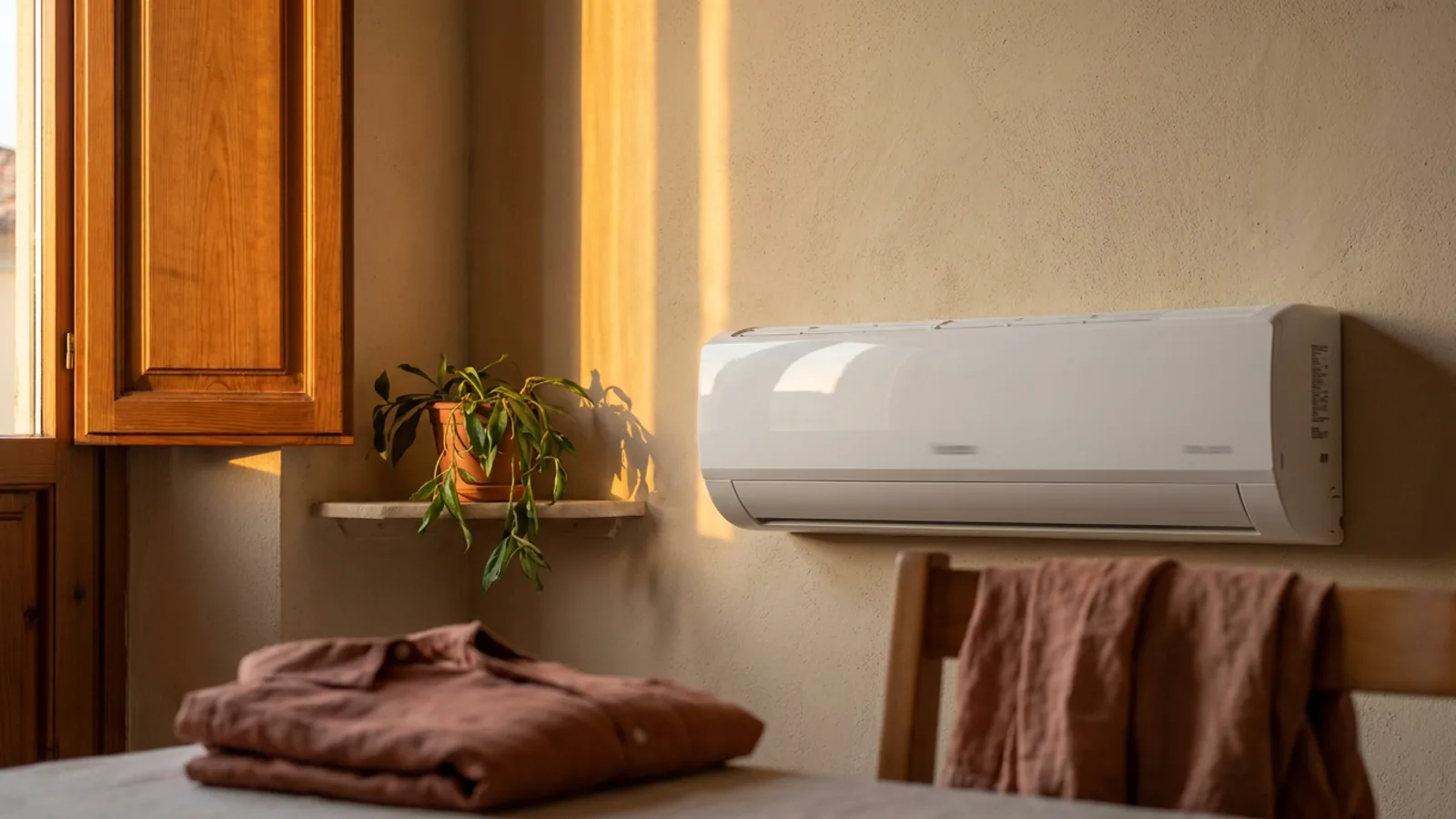
The summer that splits the flat into two camps
The first month of real heat is the moment when any shared flat discovers it has two mental models of air conditioning coexisting under the same roof. For one tenant, the AC is a resource you switch on when the room goes past twenty-nine degrees, set to twenty-five, and turn off when you leave. For another, it's a constant companion to any task: working from home with the AC on, sleeping with the AC on, showering with the AC on. These aren't absurd positions, they're different habits. But they coexist on a single bill, and that bill arrives at the end of July.
In 2026, after several years in which the price per kilowatt-hour hasn't stopped drifting upward thanks to the pressure on European energy markets —compounded by the recent instability in the Middle East over oil, which drags gas along with it— a summer electricity bill for a three-bedroom flat can comfortably go from ninety euros a month in winter to one hundred and eighty in July. That difference, split equally, becomes the season's first serious flashpoint. And unlike other flat expenses —the toilet paper, the gas bottle, the kitchen-sink plugs— the AC condenses the whole problem of unequal consumption into a single variable.
What starts as a joke about who "lives in a fridge" ends up as a passive-aggressive message in the flat's group chat at eleven at night, the day the bill arrives.
Why the equal split breaks in August
The most common model in shared flats is the simple division: the electricity bill is split equally among the tenants, and that's that. It works reasonably well eleven months of the year, when the difference in consumption between occupants is minimal —plugging in a charger, having a desk lamp on, cooking dinner— and everything evens out. It springs a leak in July and August.
The reason is geometric. A conventional air conditioner draws between eight hundred and one thousand five hundred watts while starting up and holds at around five hundred once it's reached temperature. That means a room with the AC on twelve hours a day consumes, in AC alone, around six kilowatt-hours daily. At average 2026 tariff prices, that's close to one euro twenty a day, thirty-five euros a month for a single room. If two rooms use it at that level and the third barely does, dividing the bill by three means the occupant of the third room is paying for AC they don't consume.
It's the same problem as the shared fridge with a flatmate who cooks a lot and one who doesn't, but amplified. And unlike the fridge, the AC is optional, which adds a moral dimension: "I didn't turn it on, I shouldn't pay for it".
Three models that do work
1. A fixed summer fee per room with AC
The simplest model. The flat agrees that during the hot months —say June, July, August, and the first half of September— each room that habitually runs the AC pays a fixed extra fee into the shared electricity fund. For example, twenty-five euros a month. That fee is calculated on the high side to cover the over-consumption and is renegotiated each year in light of the actual bills.
The virtue of this model is that it requires measuring nothing. There's no need to keep a tally of usage hours, nor to argue about whether someone's cheated. Whoever wants to use the AC freely, pays the fee. Whoever doesn't want to pay it, doesn't turn the AC on. The catch is that it penalises the moderate user who just wants a treat a couple of nights a week, because the fixed fee is the same. To correct for it, some flats define two tiers: a low fee for occasional use —ten or twelve euros— and a high fee for intensive use, with the ethical commitment to declare honestly.
2. A split proportional to actual use
Fairer, more expensive to manage. Each room keeps an approximate tally of the AC's usage hours over the month. There's no need for absurd precision: it's enough for each tenant to note whether they used the AC that day and whether intensively or lightly. At the end of the month, a usage percentage per room is calculated and the portion of the bill attributable to the AC is split accordingly.
This requires a prior agreement on what's considered the "baseline" of the bill without AC —you can use the average of the months with no heating or AC, typically April or May— and everything the bill exceeds that baseline by is considered AC consumption. It's the fairest model in flats where there's genuine disparity and where one of the tenants has no AC in their room. The friction shows up when someone forgets to note it down and the rest suspect they're under-reporting their usage.
3. A shared thermostat and a common schedule
The least popular model and, in some flats, the most effective. It consists of agreeing on a common protocol for AC use in the shared areas —living room and kitchen— and leaving the AC in the individual rooms to each tenant, without it entering the shared split. For example: the living-room AC is switched on from eight in the evening, at twenty-six degrees, and turned off at midnight. It's paid by the shared bill because the living room belongs to everyone. The AC in each room is paid by whoever turns it on, via a fixed room fee or a bilateral arrangement with the landlord if the units are individual.
This model only works if the flat has independent units, of course, and it demands a serious conversation about temperature. It's interesting because it eliminates the sense of unfairness and focuses the shared bill on what's genuinely shared.
The misunderstanding about degrees and health
There's a parallel debate worth closing before talking about money. Many people believe the difference between setting the AC to twenty-two and to twenty-six is cosmetic. It isn't. Each additional degree you ask of the AC below the surroundings means, according to most manufacturers, around six to eight per cent more consumption. The difference between twenty-six and twenty-two isn't marginal: it can mean thirty per cent more on the monthly AC bill.
It's not a moral argument —everyone decides how they want to live the summer— but it is an accounting one. If there's someone in the flat who wants to use the AC at twenty-two degrees, that should be reflected in their fee. If everyone agrees to keep it at twenty-six, the costs drop for everyone and the conversation gets simpler. The figure of twenty-six isn't a whim: it's the point where most European households optimise comfort and consumption, and it's the standard recommendation of the Spanish energy authorities in summer.
How to close it out without summer wrecking the household
The thermodynamic part of the problem —how much each person consumes— isn't managed from a phone. The economic part is. Any decent system should give you a shared fund for the electricity, the ability to add seasonal fees per room, and an always-updated balance of who contributes what. This is what a tool like ControlarGastos does, and it splits the cents by largest remainder, not by truncation, so nobody always pays the rounding.
What you gain from this is trivial but important: when the July bill arrives, there's no need to open a debate each time. The system already has the seasonal fee loaded, the contributions square up on their own, and the only thing left to discuss is whether to deactivate it in September or keep it. The conversation you save each month is the difference between a liveable flat and a toxic one.
Conclusion: the heat exposes the unwritten pacts
Air conditioning has an uncomfortable virtue: it doesn't negotiate. If the flat has an unwritten agreement about how expenses are split, July puts it to the test. What survives the winter —because the cost is low and the individual difference minimal— breaks down at thirty-seven degrees, when a kilowatt costs five per cent more at peak hours and each room is a different consumer.
Summer cohabitation isn't measured by the living-room temperature, but by the ease with which the flat can look at its bill without anyone raising their voice. And that's decided in May, when it's still cool and the debate is theoretical, not in August at two in the morning after an underlined message.
Keep reading

One person's pet in a shared flat: who pays the extra?
A dog or a cat brings costs that don't show up in the flat's rent: an extra deposit, occasional damage, hair on the shared sofa. Splitting it well keeps the pet from becoming the living room's silent conflict.

Sharing Netflix/Spotify in a flat: the legal grey area
The platforms are tightening their same-household clauses and shared flats live in an increasingly uncomfortable grey area. How to organise the flat's streaming without drama or unexpected cut-offs.

The flatmates' fridge: yoghurts with surnames
The labelling system on the yoghurts, the assigned shelves, the cold war over shared products. The fridge isn't an appliance, it's the emotional thermometer of a shared flat.
Sound familiar?
ControlarGastos automates splitting expenses with your partner, flatmates and friends. Split to the cent, no arguments.
Start for free