Subsidised private school cost: enrolment, lunch, uniforms
The state-subsidised private school is sold as almost-free education and ends up costing between one thousand five hundred and three thousand euros a year per child. We break down fees, lunch, uniforms, books, the parents' association, outings and activities so the real figure stops being a surprise.

Quick answer
A subsidised private school is not free: between the voluntary fee, lunch, books, uniforms, outings and the parents association, a family pays 1,500 to 3,000 euros a year per child. Most of those items are per child, not per family, so with two children the figure doubles.
The "free" that costs two thousand euros a year
In the social conversation of any family with school-age children, sooner or later the line comes up: "in the end we put them in the subsidised private school, practically free." The intention is good, the information incomplete. The state-subsidised private school, at least in Spain's big cities in 2026, isn't free. The ordinary teaching, the part covered by the public agreement, is indeed funded with public money. The rest, which is quite a lot, isn't.
A family with one child in a subsidised private school in a mid-range urban area can end up paying between 1,500 and 3,000 euros a year, not counting very specific optional extracurriculars. With two children, we're talking about an annual cost that gets close to a month's rent. This isn't a criticism of the model, it's an observation. That money exists, it comes out of the family budget, and it's worth looking it in the eye before enrolling, not in October when the first direct debits arrive.
The most useful thing you can do about it, calmly, is to break down the full bill. Not to frighten anyone; to plan. Knowing that in September you'll pay for uniforms and books, in October the voluntary fee for the first term, in November the museum outing and in May the end-of-year trip is what separates a serene family budget from one in permanent emergency mode.
Why the figure always falls short
The most common reason families underestimate the cost of the subsidised school is structural: the school communicates the expenses one by one, at different moments of the year, in different circulars. Enrolment in June, books in August, lunch from September to June, the voluntary fee in October, outings depending on the term, the trip in April or May, the parents' association separately, the extracurriculars separately. Each one is manageable. The annual sum is rarely presented together.
The result is that the family slips into a drip-feed dynamic of payments and rarely sits down to do the total sum. When they do, two years later, the real figure surprises even those who keep their accounts carefully. And when there are two children, the surprise doubles with an important nuance: many costs (uniforms, books, materials) are per child, not per family.
The big blocks of the annual cost
1. The school's "voluntary" fee
The subsidised private school can request voluntary contributions for complementary services or for activities not covered by the agreement. The voluntariness is legally real, in practice it's ambiguous. The fee varies a great deal by school and area: from around 30 euros a month per family in modest schools to 200 or more in schools in well-off areas. Multiplied by the school months, we're talking about between 300 and 2,000 euros a year per child on this concept alone.
It's worth asking exactly what the fee covers: activities within school hours, specific materials, reinforced languages, the digital platform. What's opaque is what's expensive.
2. Lunch
Lunch is, almost always, the highest recurring expense. In 2026 the usual prices for the daily menu in an urban subsidised school range between 6.50 and 9 euros, depending on the region and the school. With a school year of around 175 school days, assuming lunch every day, that comes to between 1,140 and 1,575 euros a year per child. It's the block most worth reviewing: is there an option to eat at home some days? Is there a grant? Is the difference between two schools in the neighbourhood significant?
Many families take lunch as inevitable because both parents work, which is reasonable. Others take it on out of inertia. The annual figure justifies at least doing the maths.
3. Books and school supplies
Textbooks, depending on each region's free-provision or loan scheme, can cost between 0 and 350 euros a year per child. Where well-run book bank systems exist, the cost is residual. Where they don't, the first fortnight of September takes a bite of two to three hundred euros without blinking.
The complementary materials (notebooks, backpacks, planners, instruments for music, sports kit) easily add another 80-150 euros at the start of the year, plus replacements over the course of it.
4. Uniforms
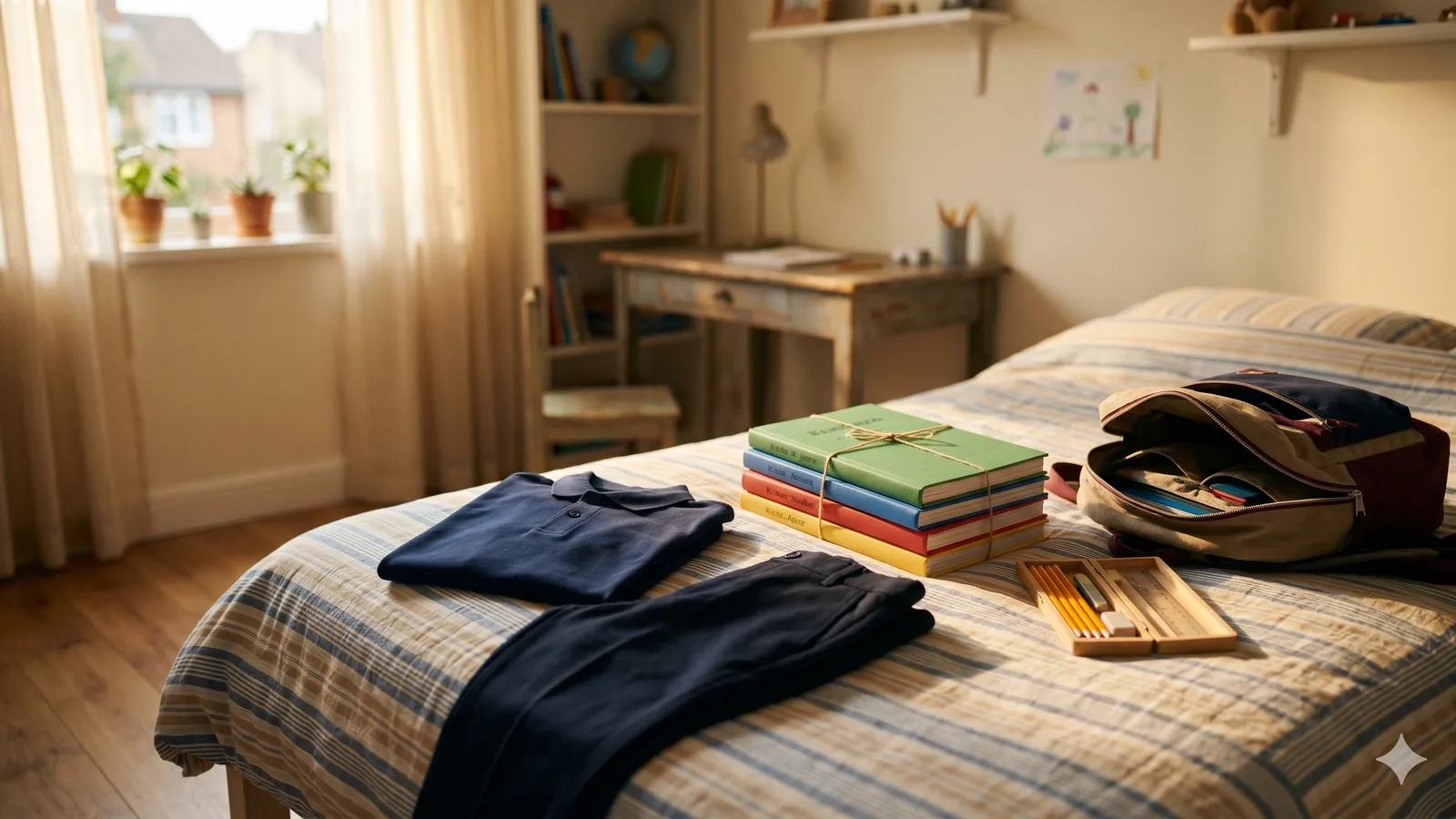
In subsidised schools that require a uniform, the cost of kitting out a child from scratch (T-shirts, polos, trousers, jumper, full tracksuit, specific trainers) rarely comes in under 200 euros and can get close to 400 when there are premium pieces. On top of this comes the annual replacement: what grows, what wears out, what gets lost. A family should count on a minimum of 100 euros a year in uniform upkeep after the initial kitting-out.
5. Outings, excursions and the trip
In a typical year, a child in a subsidised school has between three and six paid outings (museum, school farm, theatre), at 10 to 35 euros each. Added up, that's between 60 and 200 euros a year per child. From year four or five of primary onwards, the multi-day trip starts to appear, which can run from 200 to 500 euros, and in secondary the end-of-stage trips or exchanges can climb significantly higher.
6. Parents' association and complementary activities
The parents' association fee is usually modest (20-50 euros a year) and tends to give access to shared resources. The extracurricular activities organised by the school or by the association (languages, sport, music) are separate and range between 200 and 600 euros a year per activity and per child.
The problem of the payment rhythm
More uncomfortable than the total amount is the calendar. The concentration of expenses at the start of the year (enrolment, uniforms, books, materials, the first month of lunch) can leave the family facing a September that swallows 1,000 or 1,200 euros in a few weeks per child. June is the peak month for many family budgets not because of unforeseen events, but because of insufficient planning of the prior school spending.
The sensible strategy is the same one any serious financial adviser recommends: provision monthly. If the estimated annual cost per child is 2,400 euros, that's 200 a month. Set aside in an auxiliary account, it stops September being a traumatic month and turns it into a boring one, which is exactly what we want.
How to track it without getting lost
The second part of the work is keeping the real account, not the estimated one. The recommended approach is to log each school expense in a separate, identifiable category, tagged by child. At the end of the year, the family knows exactly how much the school cost and can adjust the following year's provision with real data instead of impressions. Any decent system for managing family expenses should let you create that category tagged by child and review the aggregate by term or by year. ControlarGastos does exactly that, and it splits the cents by largest remainder, not by truncation, which matters when the family divides expenses between the two parents and doesn't want one of them always carrying the rounding on each school outing.
What's really powerful isn't the final figure, it's what comes from tracking two years in a row with good data: spotting where the leak is (does lunch represent 60 per cent of the spend?, have the outings shot up this year?), discussing it as a couple with data and making decisions based on something more solid than a hunch.
Conclusion: your children's education isn't a surprise expense
The decision to enrol in a subsidised school is legitimate and, for many families, optimal. What isn't optimal is going into it without having looked at the full bill. That exercise, done once at the start of each stage (preschool, primary, secondary), saves years of small financial crises and of a vague sense of "we're worse off this year" without knowing why.
The subsidised private school isn't free. It's affordable if you plan, expensive if you improvise. The difference between the two versions is a fifteen-minute spreadsheet and a monthly kitty.
Frequently asked questions
How much does a subsidised private school cost per year?
Between 1,500 and 3,000 euros per child in an average urban area, not counting very specific extracurriculars. A typical breakdown: lunch 1,140 to 1,575 euros, voluntary fee 300 to 2,000, books and materials up to 500, uniform 200 to 400 in year one, outings 60 to 200.
How much does school lunch cost?
Between 6.50 and 9 euros for the daily menu in 2026, depending on region and school. Over roughly 175 school days with lunch every day, that is 1,140 to 1,575 euros a year per child. It is the most expensive block of the year, and the one with most room to trim.
Is the voluntary fee actually compulsory?
No: the teaching covered by the agreement is publicly funded and the contribution is legally voluntary. In practice the line is blurred. It ranges from about 30 euros a month per family in modest schools to 200 or more in affluent areas: 300 to 2,000 euros a year per child.
How do I stop September swallowing a thousand euros at once?
By provisioning all year. If the estimated annual cost per child is 2,400 euros, set aside 200 a month in a separate account. The start of term stacks enrolment, uniforms, books, materials and the first lunch instalment: 1,000 to 1,200 euros per child in a few weeks.
Keep reading
Kids' clothing: the real cost and how to split it
Little ones' sizes last three or six months, garments wear out before they're worn out and the wardrobe is a bottomless pit. Looking at the real annual cost helps you budget better and split it sensibly between both parents.

Children's birthdays: the real annual cost
Adding your own child's birthday to the fifteen or twenty other kids' birthdays you attend each year gives you a figure almost nobody looks at. Doing so changes the family conversation and the calendar.

A kid's allowance: shared expense or each parent's own?
When to start the allowance, how much to give and, above all, whether it comes from the shared family pot or each parent chips in their part. A decision that says more about the family than about the child.
Sound familiar?
ControlarGastos automates splitting expenses with your partner, flatmates and friends. Split to the cent, no arguments.
Start for free