Shared cleaning supplies: the contested corner
Detergent, kitchen paper, and dishwashing liquid are the grey area where the most friction is generated in a shared flat. Here's a roadmap so that cleaning stops being a passive-aggressive affair.

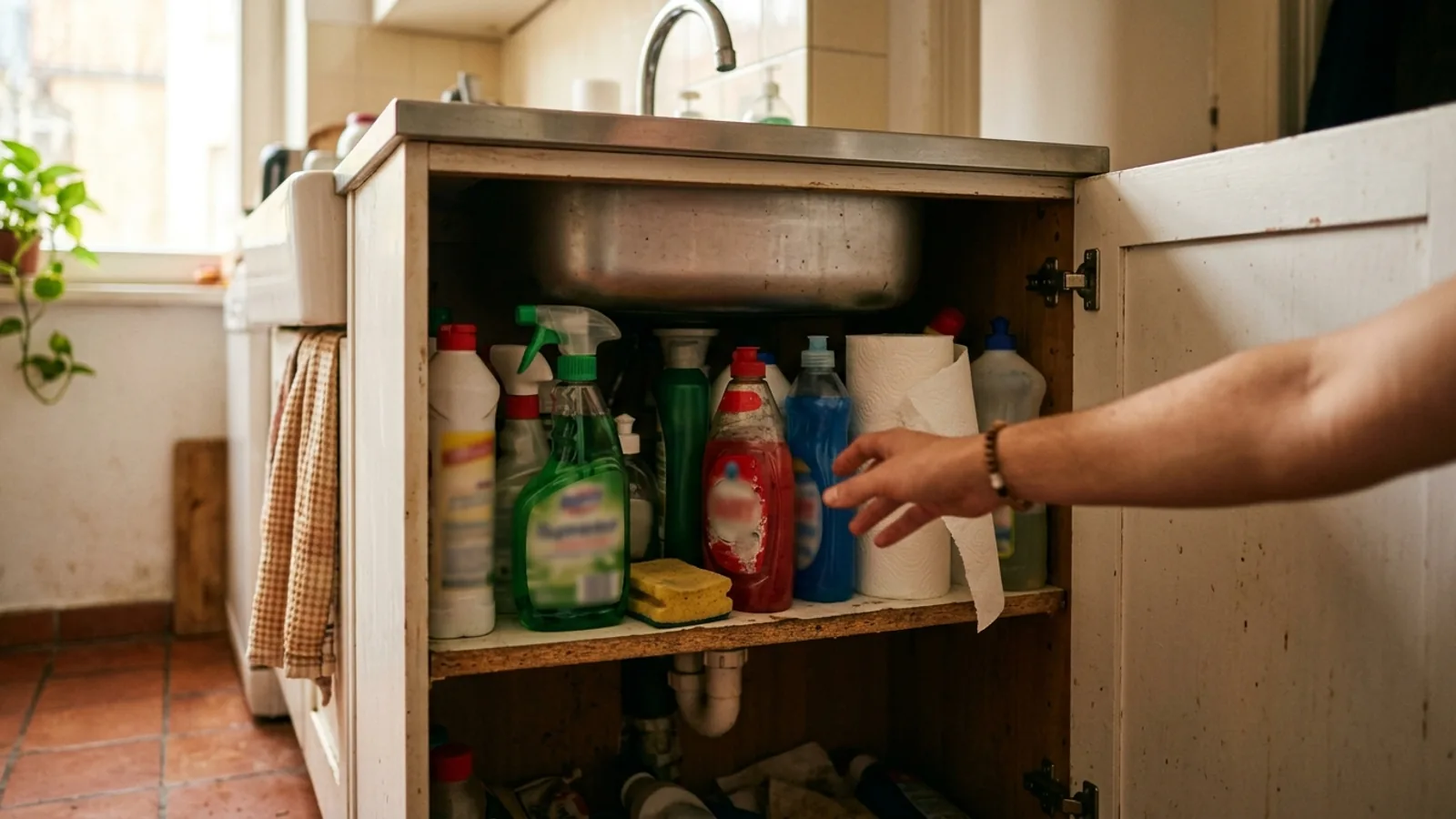
The cleaning-supplies cupboard isn't neutral
In any shared flat there's a piece of furniture that looks minor and ends up condensing all the tensions of living together. It's that cupboard under the sink, or that shelf in the laundry room, where the rolls of kitchen paper pile up alongside the bottles of dishwashing liquid, the laundry detergent, the rags, the cloths, and half a dozen sprays whose origin nobody remembers anymore. Seen from outside it looks like trivial household logistics. Seen from inside it's a minefield.
The problem starts with a deceptively simple question: when a product runs out, who replaces it, with whose money, and under what criteria does it go into the shared split. People who share flats have spent years answering that question on the fly, and that's why the solutions tend to last three months at most. Then someone changes their work shift, another person starts working from home, a partner who sleeps over four nights a week shows up, and the delicate balance collapses.
In 2026, with the cleaning basket having grown steadily more expensive for several years thanks to rising energy and chemical raw-material costs, the monthly cost of these products for a three-person household rarely drops below forty euros. That makes it a line item visible enough to argue about and diffuse enough never to be fully resolved.
Why the "whoever runs out buys it" model always breaks
The most widespread model in shared flats is informal: when the detergent runs out, it's bought by whoever notices first. It sounds fair. It isn't. What that system measures isn't consumption, but attention. And attention to the state of the cupboard is unevenly distributed.
One person in the flat checks out of habit what's missing before heading down to the supermarket. Another only buys when they run out of kitchen paper in the middle of cooking dinner. A third never notices. The result is that two people in the flat buy eighty per cent of the shared products while the third consumes without replacing, with no ill intent, simply because their threshold for detecting an empty container is higher.
The friction shows up within a few months. Whoever buys starts keeping a mental tally, and the mental tally always inflates the numbers in favour of whoever remembers. The uncomfortable conversation gets postponed until it erupts on a random Sunday over a roll of toilet paper costing three euros seventy. What's really being negotiated by then is no longer the paper: it's who has felt invisible over the last quarter.
Three models that do last more than three months
1. The monthly shared kitty with a cap
Each tenant contributes a fixed amount at the start of the month to a shared fund dedicated only to cleaning supplies, paper, and bathroom consumables. Fifteen or twenty euros per person is usually enough for a three-person household in a big city. The money is spent on whatever's needed without arguing over each purchase; at the end of the month, whatever's left stays in the fund and reduces the next month's contribution.
The virtue of this model is that it separates the cost from the decision. Nobody has to justify why they bought one brand or another as long as the cap is respected. The condition for it to work is defining what goes into the kitty: laundry detergent, dishwashing liquid, kitchen paper, toilet paper, bin bags, shared hand soap, and general cleaners. Whatever is for personal use —shampoo, shower gel, deodorants— stays out. The boundary has to be explicit and written down in the flat's messaging group, because oral memory gets rewritten.
2. Rotation with a shared list and reimbursement
One person handles all the shared-product shopping each month and keeps the receipts. At the end of the month, they total it up and divide it among the tenants. The next month it's someone else's turn. The rotation shares both the logistics work and the money fronting.
This model fits best in flats where one of the people has much more free time than the others. It lets you recognise that time as part of the split and not as an invisible burden. The usual trap is not keeping records in real time: the receipt gets lost, the amount gets rounded up or down, and by the fourth month nobody remembers exactly what each person fronted. That's why it's worth logging the purchases the same day, ideally with a photo of the receipt in a shared note.
3. A split proportional to actual use
Less common but fairer when there are strong imbalances in consumption. For example, when a tenant has a partner who spends four nights a week in the flat and therefore consumes toilet paper, hot water, and detergent like half an extra tenant. Or when someone works from home every day and uses the kitchen paper, the dishwashing liquid, and the bin more than the person who's out twelve hours a day.
The aim here isn't to measure each sheet of paper: that's madness. The aim is to agree on a different contribution percentage. Instead of a third each, two people contribute thirty per cent and the third forty. The important thing is that this conversation happens with a cool head, ideally when a tenant changes or the contract is renewed, and not in the middle of a conflict. And it's worth reviewing every six months, because circumstances change.
The invisible problem: what each person considers "decent cleaning"
There's a secondary axis that almost never gets discussed and that finishes off the complication of the split: the standard of cleaning isn't the same for everyone. One person in the flat buys a six-euro supermarket-brand detergent that lasts them two months. Another prefers a twelve-euro premium brand that gives them fewer loads, but they believe it cleans better and smells like their childhood. The third doesn't even understand there's a difference.
When everything goes into the shared kitty, that gap in standards shows up within a few weeks. Whoever goes for the cheap option feels they're subsidising the whims of whoever goes for the good stuff. Whoever goes for the good stuff feels they're being forced to use products they don't like. And the conversation ends up being about brands, not about money.
The solution isn't to seek an impossible consensus on the brand, but to set a budget per category within the fund. For example: the laundry detergent can't cost more than eight euros a container, the dishwashing liquid no more than five, and the person who wants to use something more expensive pays for it out of their own pocket. This turns an emotional argument into a boring rule, which is exactly what a household rule has to be in order to last.
How to close it out without it becoming a monthly war report
The logistical part —restocking the kitchen paper, buying bleach— isn't automated. But the money is. Any decent system should give you a shared fund to log the purchases in with a photo of the receipt, a split to the cent among the flat's members, and an always-updated balance of who owes whom. ControlarGastos does exactly that, and it splits the cents by largest remainder, not by truncation, so nobody always pays the rounding.
What a tool like this brings isn't magic: it's moving the conversation to the app. When someone buys detergent, they log it in thirty seconds and that's it. There's no need to talk about it. The friction of the mental tally disappears, and with it half the arguments. What's left is what matters: if someone feels they're always restocking, that's no longer a suspicion, it's data visible to everyone on screen.
The other advantage is that when someone leaves or joins the flat, the balance closes out cleanly. There's no need to do emotional archaeology to reconstruct what each person owes.
A not-so-glamorous close
Shared cleaning isn't an economic problem, even though it's expressed in cents. It's a problem of visibility. When the work and the expense are invisible, they always get done by the same person, and that person ends up leaving the flat or keeping the tally with resentment. Any system —shared kitty, rotation, proportional— works, as long as it makes visible who contributes what, and as long as the first month is respected.
Few things age as badly as a household agreement improvised in August of the first year. But few things are as cheap as sitting down twenty minutes a month to square up the cupboard before the cupboard squares up with you.
Keep reading

One person's pet in a shared flat: who pays the extra?
A dog or a cat brings costs that don't show up in the flat's rent: an extra deposit, occasional damage, hair on the shared sofa. Splitting it well keeps the pet from becoming the living room's silent conflict.

Rounds at the bar with flatmates and friends: a mini-split
The corner bar is the fifth flatmate. How to handle the rounds so nobody ends up paying four times in a row, without turning Friday into a spreadsheet.

Beers at the bar: the phone-calculator ending
Three rounds, eight beers, three plates of patatas bravas, two alcohol-free drinks. The arithmetic at the end can take fifteen minutes or thirty seconds. The difference is in how you model the problem before you order.
Sound familiar?
ControlarGastos automates splitting expenses with your partner, flatmates and friends. Split to the cent, no arguments.
Start for free