Online vs in-store grocery shopping: how the split changes
Online leaves a single, traceable, welcome receipt. In-store crumbles into six small trips nobody writes down. For a couple splitting costs, that difference isn't cosmetic: it's real accounting.
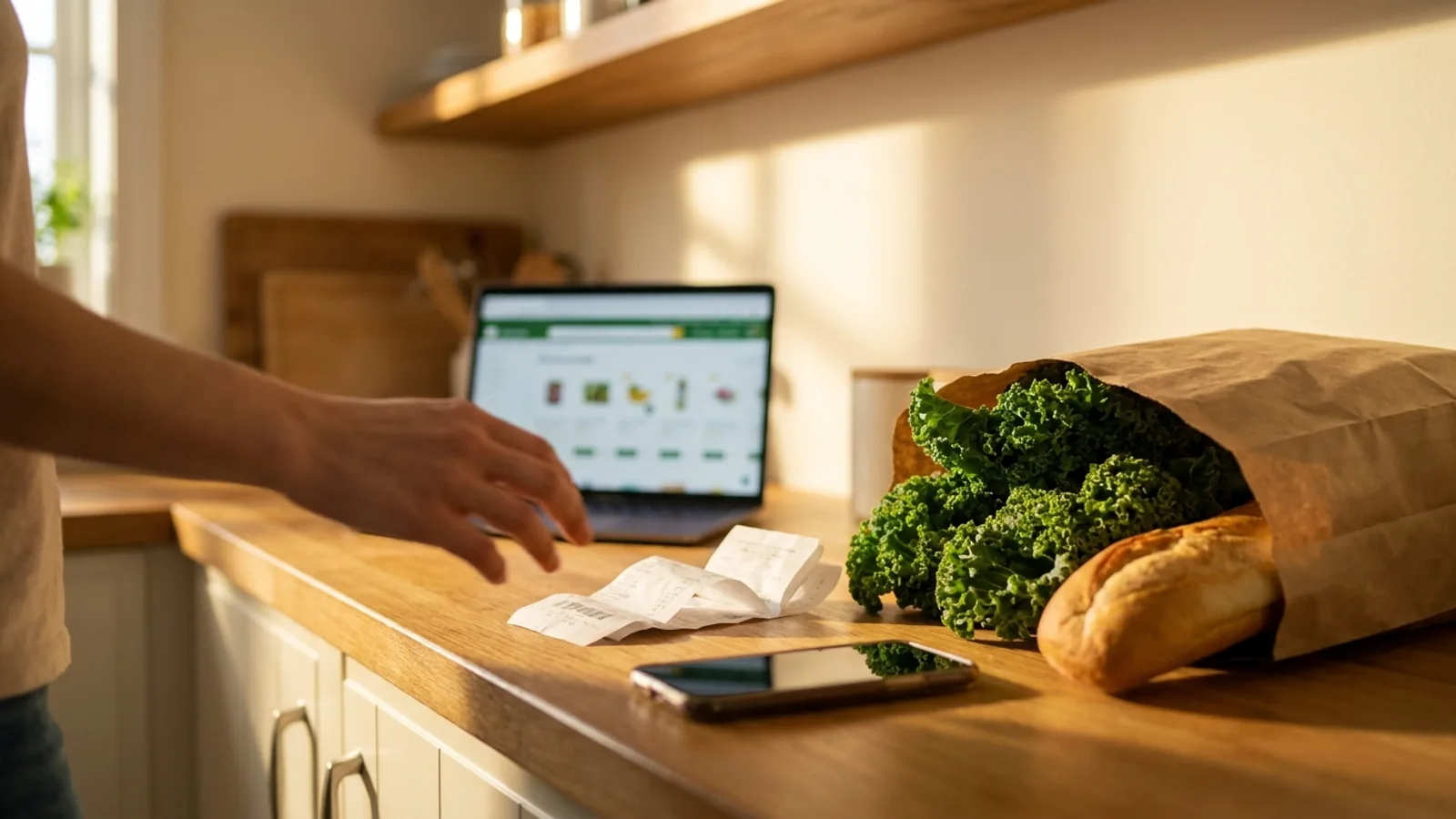
The receipt that never arrived
A couple, Friday afternoon, sits down to do the month's accounts. She did the big shop online, once, with everything: 187.42 euros, an electronic invoice in her inbox, products itemised line by line. He did "small shops", as he calls them, all week long: he popped down to the local supermarket on Tuesday for milk, Wednesday for bread and a couple of things, Thursday for dinner, Saturday morning because the oil had run out and "while he was there" he grabbed two more things. The hallway drawer has three crumpled receipts. The other three are nowhere to be found. His estimated total, from memory, is "about 70 or 80 euros". The real total, when she pulls up the statement, is 134.18.
Nobody has lied. It's what happens with fragmented in-store shopping: it evaporates. No emotional record is left, no legible receipt survives, and the figure you remember is always the one from the last trip, not the sum of all seven. For a couple trying to split shared costs honestly, this isn't a quaint detail — it's the main source of monthly imbalances in the food block.
Online shopping and in-store shopping are two different systems for generating information, and that translates into two different splitting systems. It's worth understanding what you gain and what you lose with each before deciding how to combine them.
Why fragmented in-store shopping grates on the split
The friction has a technical name rarely used outside behavioural economics: recency bias. When someone tries to remember how much they've spent on something, their brain retrieves the most recent figure and uses it as an anchor, not the sum. If you've popped to the supermarket six times in a week, the last one probably cost 18 euros, and mentally you "round" the total to 50 or 60. The reality is usually between 1.5 and 2.5 times that figure.
To that you add the effect of the small pack. Buying a 250-gram bag of coffee four times in a month, instead of a one-kilo bag in the big shop, comes out between 20% and 35% more expensive per unit — and nobody notices because they never have both receipts side by side. The sustained food inflation since 2021, which has especially squeezed own-brand products and basics, has amplified this fragmentation surcharge. Today, making five small trips isn't "almost the same" as one big shop: it's clearly worse for the shared wallet.
And then there's the asymmetry between the two members of the couple. Almost always one does "the big one" and the other does "the small ones". Since the big one has a receipt and the small ones don't, in both their minds the one doing the big shop comes across as the one contributing the most. Even when the real figure is tied, or even reversed.
The three ways to combine online and in-store, ranked
1. The big online shop + controlled in-store top-ups
It's the model that best combines traceability and flexibility. Once a week or every fortnight, you do a big online shop covering 70 to 80% of the basket: dry staples, frozen goods, household products, drinks, heavy items. It arrives home, gets recorded in your email with an invoice, and is charged to the shared spending with a single entry.
Whatever's missing — fresh fruit, the day's bread, a specific vegetable, whatever ran out early — is bought in person, but with an agreement: each trip generates a photo of the receipt as soon as you leave the supermarket, which goes into a shared folder or an expenses app. The photo isn't about distrust, it's about memory. Without a photo, the trip didn't exist on the books, and the figure stays in the head of just one person.
A plausible numerical example: a couple spending 520 euros a month on food. 380 comes in through the big online shop, perfectly traceable. The remaining 140 is spread across six or eight small trips. If they're documented, the split is exact. If they're not documented, it's common for one month to have one person putting in 90 and the other 50, and the next month the other way around, without either of them knowing.
2. In-store only, but with a weekly "common kitty"
It works for couples who prefer to handle the product, see the fruit, decide on the fly. Here traceability is replaced by a shared-account-style agreement: each one contributes a fixed weekly amount to a kitty — physical or virtual — used exclusively for food. Trips come out of the kitty, receipts are kept in a clip hanging off the fridge, and at the end of the month you check whether the kitty balanced, had a surplus or fell short.
Advantage: zero arguments about who paid for what, because nobody paid individually. Drawback: it requires initial discipline to calibrate the kitty amount — the first two months it usually falls short — and demands a conversation when the pattern changes (one stops eating at home because of work, a fortnightly guest arrives).
3. Online only, subscription and scheduled top-ups
It's the cleanest model in accounting terms and the most rigid in everyday-life terms. The whole basket comes in through two or three online orders a month, scheduled, with basics on subscription and planned top-ups. Every euro is documented, the split is trivial, and the risk of invisible spending disappears.
The cost is paid in flexibility: it's not easy to adapt to an improvised menu, fresh products don't always arrive at the desired ripeness, and you usually end up paying for a small share of one-off in-store trips that break the purity of the model. For couples with tight schedules and little patience for crumpled receipts, it's usually the most sustainable system over a year.
The secondary problem: cross-promotions
One aspect the average couple doesn't consider is that aggressive promotions — 70% off the second unit, family packs, volume discounts — work differently online and in store. Online tends to display them with clear labels but apply them worse in the final basket; in store they're applied instantly but you have to keep an eye on the shelf. Buying the same thing "in the wrong place" can mean a difference of 8% to 15% a month on an average basket.
This doesn't affect the split between the two members, but it does affect the absolute spending being split. It's worth reviewing quarterly whether a specific category — household goods, tinned food, drinks — has migrated to the wrong channel.
How to close the split without monthly arguments
The solution isn't ideological (online is better than in store, or the other way around). The solution is structural: any euro spent on shared food must be recorded at the moment, not at the end of the month. It doesn't matter whether it's because an automatic email arrives, because you take a photo of the receipt, or because it goes into a common kitty; what matters is that the data exists before the brain rounds it off.
A splitting tool serves here as an external memory, not as a referee. Any decent system should let you log the supermarket expense in seconds, tag it under "shared food", and reconcile the balance with the other party without having to open three apps. ControlarGastos does exactly that, and splits the cents by largest remainder, not by truncation, so the rounding on each split receipt doesn't always fall on the same member of the couple at the end of the month.
Once the information exists, the split stops being a conversation about trust and becomes an arithmetic operation. Which is exactly what it should be.
Conclusion: the shopping model is also a relationship model
Choosing how the couple's shopping is done isn't only a logistical decision. It's a decision about how much information you want to generate and how much willingness there is to process it. Couples who feel good about the big online shop aren't tidier: they're the ones who've decided to pay for the freedom of not having to remember anything with the rigidity of a weekly calendar. The ones who prefer small trips aren't more chaotic: they're choosing flexibility, and so they have to take on the cost of photographing receipts for years.
What doesn't work is choosing flexibility and then not documenting. That crossover, which looks like the most comfortable one, is the one that ends the month with the most expensive sentence: "I thought we were even".
Keep reading

Split expenses by income: formula, example and calculator
How to split the rent and the shared bills in proportion to what each person earns, with the formula, a worked example and a calculator that does it for you.

Paying for your partner's car as a couple: the big mistake
Paying half the payment on the car your partner brought into the relationship seems fair, but it creates an invisible liability that sooner or later blows up. The difference between use and ownership changes everything.

The 50/30/20 Rule Applied to a Couple With Two Salaries
The 50/30/20 rule works when only one person earns. As a couple it breaks down because needs start to be yours, mine and ours. How to adapt it without arguing every month.
Sound familiar?
ControlarGastos automates splitting expenses with your partner, flatmates and friends. Split to the cent, no arguments.
Start for free